Introduction
The key Questions to Ask a Custom Home Builder cover experience, project history, communication, budget, scope, timeline, pre-construction planning, change management, quality control, references, insurance, and credentials before construction begins.
Author: Tigo Builders
Last Updated: November 5, 2026
Choosing a builder is one of the most important decisions in a Custom Home project.
Price matters, but it should not be the only factor.
Homeowners should also understand how the builder plans, communicates, manages trades, tracks costs, handles changes, and protects quality.
The right questions can reveal how organized the construction process may be before work begins.
What Should You Ask a Builder Before Starting a Custom Home?
Start with questions that reveal how the builder works, not only what the project may cost.
Ask about:
- Relevant experience
- Similar projects
- References
- Pre-construction planning
- Scope
- Budgeting
- Allowances
- Exclusions
- Scheduling
- Communication
- Quality control
These Questions to Ask a Custom Home Builder help homeowners compare more than proposals.
They help compare project-management approaches.
How Much Custom Home Experience Should a Builder Have?
There is no single number of years that automatically proves a builder is qualified.
Relevant experience matters more than a simple number.
Ask whether the builder has completed projects with similar complexity, architectural details, materials, or construction challenges.
A builder may have many years of experience but limited exposure to the type of home you are planning.
Therefore, ask for context.
What Type of Experience Is Most Relevant?
Look for experience that relates to the project you are actually building.
That may include:
- Custom Homes
- High-end finishes
- Complex additions
- Detailed millwork
- Outdoor living
- Specialty materials
- Architect-led projects
- Second-home projects
Relevant experience can help a builder recognize coordination needs earlier.
However, every project still requires project-specific planning.
Should You Ask to See Similar Completed Projects?
Yes.
Completed projects can provide useful evidence of craftsmanship, finish quality, and attention to detail.
Look beyond the overall room.
Pay attention to:
- Material transitions
- Trim alignment
- Cabinetry details
- Finish quality
- Exterior details
- Consistency
- Custom craftsmanship
A polished photograph can show design.
It may not show how the builder communicated, managed costs, or handled problems.
Therefore, portfolio review should be combined with other questions.
Should You Ask to See Work in Progress?
It can be useful when appropriate and when access is permitted.
A project under construction may show organization, sequencing, protection of finished work, and coordination between trades.
However, active job sites involve safety and privacy considerations.
Homeowners should not expect unrestricted access to another client’s property.
What Should You Ask About References?
Ask whether the builder can provide references from past clients.
The National Association of Home Builders recommends asking builders for previous customer references and whether those customers would hire the builder again.
Useful questions for references include:
- Was communication clear?
- Was the builder organized?
- Were cost changes explained?
- Were schedule changes communicated?
- How were problems handled?
- Would you hire the builder again?
Do not focus only on whether the client “liked” the builder.
Ask about the actual construction experience.
Why Are Recent References Helpful?
Recent references can provide insight into how the company currently operates.
Teams, processes, suppliers, and project-management systems can change over time.
Therefore, recent client experiences may provide useful context.
Older projects can still be valuable for evaluating long-term craftsmanship.
The strongest reference review may include both perspectives.
What Should You Ask About Builder Communication?
Ask how project information will be shared and who will be responsible for communication.
Potential questions include:
- Who is my main contact?
- How often are updates provided?
- How are decisions documented?
- How are budget changes communicated?
- How are schedule changes explained?
- How are design questions handled?
Clear communication becomes especially important when homeowners are not regularly at the property.
How Important Is Communication for Second-Home Owners?
It can be particularly important.
Many second-home owners may be away while construction is underway.
Written updates, progress photos, decision tracking, and schedule communication can help owners remain involved remotely.
The exact system varies by builder.
The important question is whether the process is clear before construction begins.
When Should the Builder Become Involved?
A builder can often provide useful input before the design is completely finalized.
Early involvement may support:
- Budgeting
- Constructability
- Procurement
- Material availability
- Scheduling
- Design coordination
- Value engineering
This does not mean the builder replaces the architect.
The architect and builder bring different expertise.
Why Can Early Builder Involvement Improve Planning?
A builder can connect architectural decisions with real construction methods, labor, materials, sequencing, and procurement.
That feedback may reveal issues while the design still has flexibility.
In 2026, AIA and AGC released a framework emphasizing early contractor engagement, clear roles, communication, constructability, and cost certainty.
For Custom Homes, that collaboration can help owners make more informed decisions before construction starts.
What Should You Ask About Pre-Construction Planning?
Ask what happens between early discussions and the start of construction.
The process may include:
- Scope development
- Drawing review
- Budget refinement
- Material planning
- Permit coordination
- Procurement
- Scheduling
- Trade coordination
- Design clarification
The exact process varies by project.
However, homeowners should understand how the builder prepares before crews arrive on-site.
What Should Be Included in the Project Scope?
The scope should clearly describe what the builder is expected to provide.
Important categories may include:
- Labor
- Materials
- Subcontractors
- Specialty work
- Allowances
- Owner-supplied items
- Exclusions
- Unfinished selections
A clear scope helps homeowners understand what they are comparing.
Two proposals with different totals may also include very different work.
Why Can Comparing Only the Final Price Be Misleading?
One proposal may include work that another excludes.
Another may use lower allowances or unresolved assumptions.
Therefore, the total price alone does not show whether two proposals cover the same project.
NAHB advises consumers to look for complete, clearly written agreements and to be cautious about unusually low-priced bids.
A lower number may be attractive.
However, homeowners should first understand what is behind that number.
What Should You Ask About the Construction Budget?
Ask how the estimate was developed and which parts are based on confirmed information.
Important questions include:
- Which materials are priced?
- Which selections remain open?
- What assumptions were used?
- Which items are allowances?
- What is excluded?
- Which prices require further confirmation?
Budget transparency helps homeowners distinguish known costs from unresolved decisions.
What Is a Preliminary Estimate?
A preliminary estimate is an early financial view based on the information currently available.
It may include assumptions because drawings, selections, or trade pricing are still developing.
Therefore, homeowners should ask how the estimate may change as the design becomes more detailed.
A preliminary estimate can be useful without being treated as the final construction price.
Why Should Pricing Assumptions Be Explained?
Assumptions show where complete information is not yet available.
For example, cabinetry may not be fully designed.
Tile may not yet be selected.
A specialty feature may still need trade pricing.
If homeowners know those assumptions, they can better understand how much certainty exists in the current construction budget.
What Are Allowances?
An allowance is a budget amount assigned to an item that has not yet been fully selected or priced.
Common examples may include:
- Tile
- Lighting
- Appliances
- Plumbing fixtures
- Flooring
- Countertops
- Hardware
Allowances can help planning move forward while selections are still developing.
However, the amount should reflect the expected quality level of the home.
What Should You Ask About Allowances?
Ask what type and quality of product the allowance assumes.
For example, a lighting allowance should make sense for the level of lighting the homeowner expects to select.
An unrealistic allowance may make the early budget appear lower.
Later selections may reveal a larger actual cost.
Therefore, allowance assumptions are important Questions to Ask a Custom Home Builder.
What Are Exclusions?
Exclusions are items that are not included in the builder’s proposed scope or price.
They vary by project.
Potential exclusions might involve certain landscaping, owner-supplied items, specialty systems, or work managed by others.
Never assume an item is included simply because it appears on a drawing.
Ask the builder to explain exclusions clearly.
Why Do Owner-Supplied Items Need Coordination?
Some homeowners may want to purchase certain fixtures, appliances, or specialty products directly.
That can work, but responsibilities should be clear.
Ask who handles:
- Product specifications
- Ordering
- Delivery
- Inspection
- Storage
- Installation coordination
- Missing or damaged items
Owner-supplied materials can affect both schedule and trade coordination.
What Should You Ask About the Construction Timeline?
Ask how the schedule is developed and what information it depends on.
Useful questions include:
- What must happen before construction?
- Which selections affect the schedule?
- Which materials require early ordering?
- How are trades coordinated?
- How are delays communicated?
- How are milestones updated?
Avoid relying on a completion date without understanding the assumptions behind it.
Should a Builder Guarantee That Nothing Will Delay the Project?
No responsible planning process can eliminate every source of uncertainty.
Weather, material availability, owner changes, inspections, site conditions, and design questions may affect construction.
The better question is how the builder plans for uncertainty and communicates schedule changes.
Realistic scheduling is more useful than an unsupported promise.
How Can Material Selections Affect the Schedule?
Some construction activities depend on actual product information.
Windows, cabinetry, appliances, plumbing fixtures, lighting, doors, and fabricated components may influence other work.
Lead times can also change.
Therefore, homeowners should ask when major selections must be finalized.
Current availability should be confirmed with suppliers rather than assumed from past projects.
How Should a Builder Communicate Schedule Changes?
Ask whether schedule updates are discussed verbally, documented in writing, or tracked through a project-management system.
There is no single required method for every builder.
What matters is consistency.
Homeowners should know when an important milestone changes and why.
For owners living away from Falmouth, MA, that communication can be especially valuable.
How Does Local Experience Affect Builder Selection?
Local experience can help with permitting processes, inspections, supplier relationships, seasonal planning, and construction logistics.
However, every property remains different.
A project in Falmouth, MA may have different conditions from one in Mashpee, MA, Bourne, MA, Sandwich, MA, or Woods Hole, MA.
The builder should evaluate the actual site rather than rely only on regional assumptions.
What Should You Ask About Local Permits and Inspections?
Ask who coordinates permit applications and required inspections for the project.
Responsibilities may vary depending on the work and agreement.
The Town of Falmouth, MA publishes inspection stages for applicable new construction and additions or alterations.
Those stages include foundation, rough trade, framing, insulation, and final inspections for applicable work.
Requirements should always be confirmed for the specific project.
What Should You Ask About Project Management?
Ask who organizes the day-to-day construction process.
Important questions include:
- Who coordinates trades?
- Who reviews upcoming work?
- Who tracks selections?
- Who communicates with the architect?
- Who monitors the schedule?
- Who reviews workmanship?
A Custom Home involves many connected decisions.
Clear project-management responsibility helps prevent those decisions from becoming isolated.
How Should Trade Coordination Be Managed?
Trades should be coordinated according to the sequence and requirements of the project.
One trade’s work can affect several others.
For example, cabinetry may depend on framing, electrical, plumbing, flooring, and appliance information.
The builder should manage these relationships rather than treat each trade as a separate project.
What Should You Ask About Quality Control?
Ask when and how the builder reviews completed work.
Quality control should not depend only on the final walk-through.
Potential review points may involve:
- Dimensions
- Material preparation
- Finish alignment
- Installation
- Trade coordination
- Corrective work
The exact checkpoints depend on the project.
However, homeowners should understand how workmanship is evaluated before later work covers or depends on it.
Why Is a Final Punch List Not Enough?
Some construction conditions are easier to review before finishes are installed.
Therefore, quality control should happen throughout the project.
A final punch list remains useful for identifying incomplete or corrective finish items.
However, it should be one stage of a larger quality-management process.
How Does Tigo Builders Approach These Questions?
Tigo Builders emphasizes transparent budgeting, proactive communication, early planning, realistic scheduling, detailed project management, architect collaboration, quality control, and precise craftsmanship.
For homeowners in Cape Cod, MA, including Falmouth, MA and surrounding communities, the goal is to create clear expectations before construction begins.
That can be particularly valuable for owners who spend part of the year away from the property.
The Questions to Ask a Custom Home Builder should ultimately reveal more than experience and pricing.
They should show how the builder plans to manage the entire construction process.
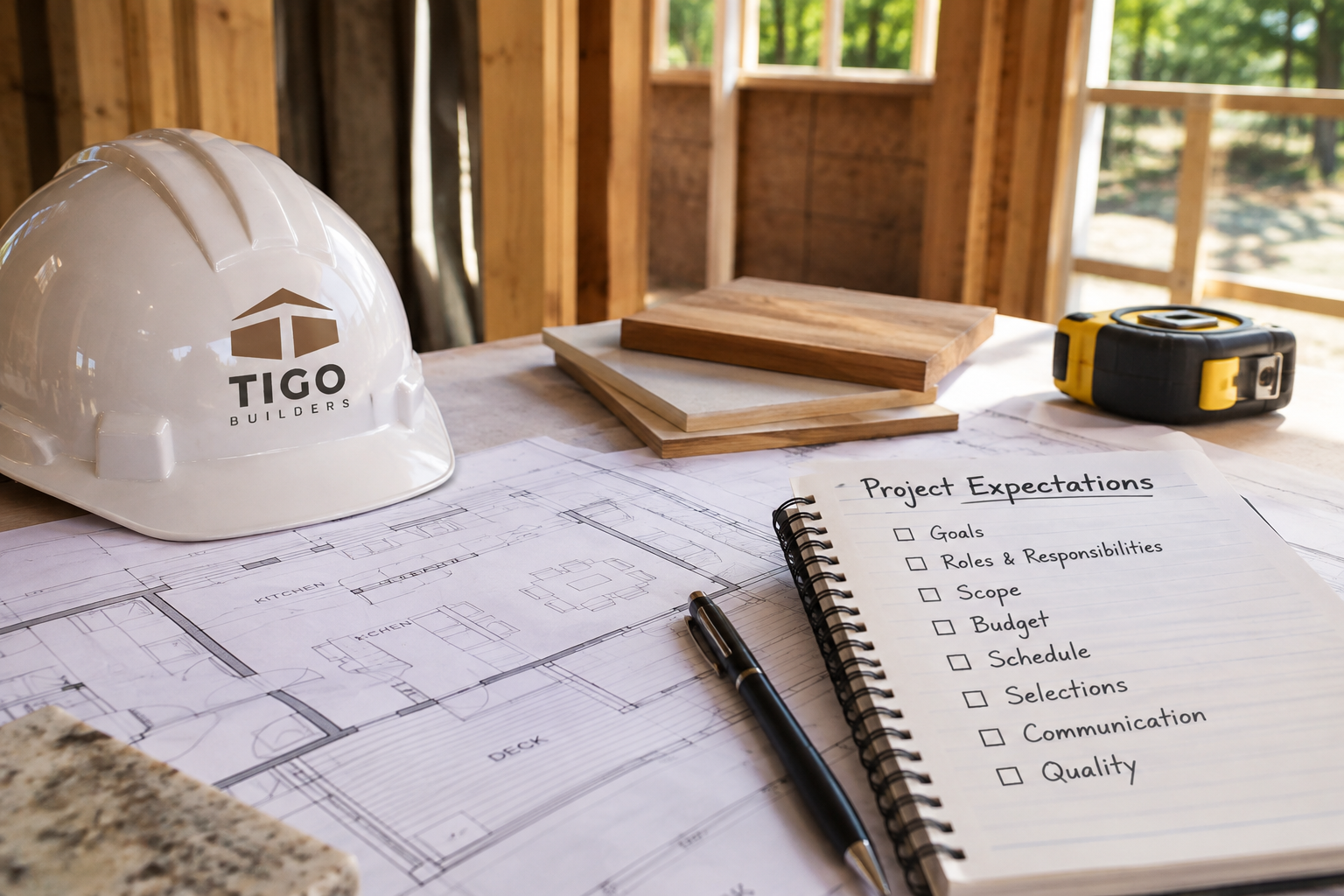
Once experience, scope, budget, allowances, scheduling, communication, and quality-control expectations are understood, homeowners can evaluate deeper responsibilities.
Those next questions include contracts, change orders, credentials, insurance, subcontractors, inspections, procurement, site supervision, problem-solving, and final project closeout.
What Should You Ask About the Construction Contract?
Ask how the written agreement defines the project before construction begins.
A clear contract should help the homeowner understand the scope, pricing structure, responsibilities, schedule expectations, allowances, exclusions, and process for changes.
Important Questions to Ask a Custom Home Builder include:
- What work is included?
- What work is excluded?
- How are allowances defined?
- How is pricing structured?
- How are payments organized?
- How are changes documented?
- What schedule assumptions apply?
- What responsibilities belong to each party?
NAHB recommends working with a builder who provides a complete, clearly written contract.
Homeowners who need help interpreting legal terms should consider advice from a qualified attorney.
Why Should Scope and Contract Language Match?
The contract should reflect what the homeowner believes is being built.
If drawings, pricing, allowances, and written scope describe different expectations, confusion can follow.
Therefore, homeowners should ask how the builder confirms that the project documents are coordinated before construction begins.
How Should Change Orders Be Handled?
Ask how project changes are documented, priced, communicated, and approved.
A change may affect more than one construction activity.
Potential impacts include:
- Labor
- Materials
- Procurement
- Fabrication
- Subcontractors
- Completed work
- Schedule
Whenever practical, the team should understand those impacts before affected work proceeds.
The exact financial responsibility for a change depends on the agreement and circumstances.
Homeowners should seek legal advice when they need help interpreting contractual responsibility.
Why Can a Small Change Affect Several Trades?
Custom Home construction is interconnected.
For example, moving cabinetry may affect electrical work, plumbing, countertops, appliances, flooring, or lighting.
As a result, the cost of one changed product may not represent the complete project impact.
This makes change management one of the important Questions to Ask a Custom Home Builder.
What Should You Ask About Credentials and Insurance?
Ask which licenses, registrations, credentials, and insurance apply to the work being proposed.
Massachusetts requirements vary by project type.
For certain construction, oversight from a licensed Construction Supervisor or registered design professional is required.
Massachusetts also distinguishes a Construction Supervisor License, or CSL, from Home Improvement Contractor registration.
They are not interchangeable.
For applicable work on existing owner-occupied residential properties with one to four units, Massachusetts requires HIC registration.
Requirements should always be confirmed for the specific project and municipality.
Should You Verify Credentials Before Construction?
Yes.
Homeowners can ask for applicable license or registration information and verify it through official Massachusetts resources.
Do not assume that every Custom Home project requires exactly the same credentials.
The appropriate requirements depend on the scope, property, and work being performed.
Who Will Supervise the Project?
Homeowners should understand who manages daily construction and who is responsible for major project decisions.
Ask:
- Who is my primary contact?
- Who is regularly on-site?
- Who coordinates subcontractors?
- Who reviews workmanship?
- Who communicates decisions?
- Who updates the schedule?
Clear responsibilities make communication easier.
They also help homeowners know who to contact when a question or field issue appears.
Why Does Project Supervision Matter?
Custom Homes involve multiple trades, suppliers, consultants, inspections, selections, and decisions.
Someone must connect those activities.
Good construction management involves more than checking whether crews are present.
It also includes planning upcoming work, coordinating information, identifying conflicts, and verifying that completed work supports later activities.
How Are Subcontractors Selected and Coordinated?
Ask how the builder evaluates and manages key trades.
Relevant factors may include:
- Experience
- Scope familiarity
- Scheduling
- Quality expectations
- Communication
- Sequencing
- Coordination with other trades
Homeowners do not necessarily need to select every subcontractor.
However, they should understand how the builder creates and manages the project team.
Why Does Trade Coordination Matter?
A subcontractor can complete one scope correctly while still creating a conflict with another trade.
For example, framing dimensions may affect cabinetry.
Electrical locations may affect millwork.
Plumbing may affect tile layouts or vanities.
Therefore, the builder should coordinate relationships between trades rather than manage each scope independently.
How Should Construction Problems Be Handled?
One of the most important Questions to Ask a Custom Home Builder is how unexpected problems are managed.
A practical process may involve:
- Identify the issue
- Gather information
- Review drawings
- Identify affected trades
- Contact the architect or engineer when appropriate
- Compare solutions
- Review budget impact
- Review schedule impact
- Communicate with the homeowner
- Document the decision
- Coordinate corrective work
- Verify the result
The exact process varies by project.
However, the builder should be able to explain how issues move from discovery to resolution.
Should a Builder Promise That No Problems Will Occur?
No project team can responsibly guarantee that every construction issue will be eliminated.
Field conditions, materials, design questions, existing structures, and other factors can create unexpected situations.
A better question is how the builder responds when a problem appears.
Strong problem-solving depends on communication, organization, professional coordination, and verification.
When Should the Architect or Engineer Become Involved?
Professional input may be appropriate when an issue affects design intent, structural requirements, engineering, or another area outside the builder’s authority.
The builder should recognize when field experience is sufficient and when professional design input is needed.
The builder should support architects and engineers rather than make unauthorized design decisions.
How Are Required Inspections Managed?
Ask who tracks required inspections and how they are coordinated with construction sequencing.
Inspection requirements depend on the work and municipality.
For applicable new construction and additions or alterations, the Town of Falmouth, MA lists inspections including foundation, rough trades, framing, insulation, and final stages.
The exact inspections required should be confirmed for the specific project.
Are Inspections the Same as Quality Control?
No.
Required municipal inspections and a builder’s internal quality-control process serve different purposes.
Passing an inspection does not replace the builder’s responsibility to review workmanship and project-specific design expectations.
Quality control may include details that are not the focus of a municipal inspection.
How Should Quality Control Be Documented?
Ask what the builder reviews before work is considered complete or ready for the next phase.
Potential checkpoints may include:
- Framing dimensions
- Material preparation
- Window and door openings
- Cabinetry coordination
- Trim alignment
- Material transitions
- Finish quality
- Corrective work
The specific process varies by builder and project.
However, quality control should occur throughout construction, not only at the final punch list.
Why Should Corrective Work Be Verified?
Fixing an issue should include confirming that the approved correction was completed properly.
Otherwise, the project may continue while the original problem remains partly unresolved.
Verification may involve dimensions, workmanship, design requirements, affected trades, or professional review.
This is another useful topic within the Questions to Ask a Custom Home Builder.
What Should You Ask About Material Procurement?
Ask how materials move from selection to ordering and delivery.
Useful questions include:
- Who tracks selections?
- Who places orders?
- Who confirms specifications?
- How are suppliers coordinated?
- How are deliveries planned?
- How are substitutions handled?
- How are long-lead products monitored?
Procurement can directly affect both schedule and construction coordination.
How Are Long-Lead Items Managed?
Some products may require earlier decisions because of fabrication or delivery time.
Examples can include windows, doors, cabinetry, custom millwork, specialty hardware, or fabricated components.
Actual lead times should always be verified with current suppliers.
The builder should explain which decisions must happen early enough to support the planned construction sequence.
What Happens When a Product Becomes Unavailable?
Ask how substitutions are evaluated.
An alternative should not be selected only because it can arrive sooner.
The team may need to compare:
- Appearance
- Dimensions
- Performance
- Durability
- Compatibility
- Installation
- Cost
- Availability
- Lead time
Architect or designer input may also be appropriate when a substitution affects design intent.
How Should a Builder Communicate With Remote Homeowners?
Homeowners who spend much of the year away from Cape Cod, MA may depend more heavily on structured communication.
Useful communication can include:
- Written progress updates
- Progress photos
- Decision tracking
- Schedule updates
- Budget updates
- Documented changes
The exact system can vary.
The important point is that the homeowner understands the communication process before construction begins.
How Often Should Project Updates Be Provided?
There is no universal frequency that fits every project.
Instead, ask what the builder’s standard process is.
Also ask how urgent decisions are handled between scheduled updates.
Communication should be frequent enough to keep homeowners informed without replacing organized project management.
What Warning Signs Should You Watch for Before Hiring a Custom Home Builder?
Some warning signs deserve additional questions before a homeowner commits.
- Unclear scope: It is difficult to understand what the price includes.
- Vague pricing: Major assumptions or allowances are not explained.
- No references: The builder avoids connecting you with past clients.
- Unrealistic schedule promises: Dates are presented without explaining assumptions.
- Weak communication: Questions remain unanswered or responsibilities are unclear.
- No clear change process: The builder cannot explain how changes are documented.
- Poor documentation: Important decisions depend only on verbal conversations.
- Pressure to decide immediately: You are pushed to commit before reviewing information.
- Unclear allowances: The builder will not explain the expected quality level.
- No management process: Responsibility for trades and decisions is unclear.
- Avoiding credential questions: Applicable insurance, licenses, or registrations are difficult to verify.
NAHB advises consumers to check references, written contracts, insurance, communication, and unusually low bids when evaluating builders.
No single warning sign automatically proves that a builder is unsuitable.
However, unclear answers should lead to additional investigation before committing.
What Questions Should You Ask a Custom Home Builder Before Signing?
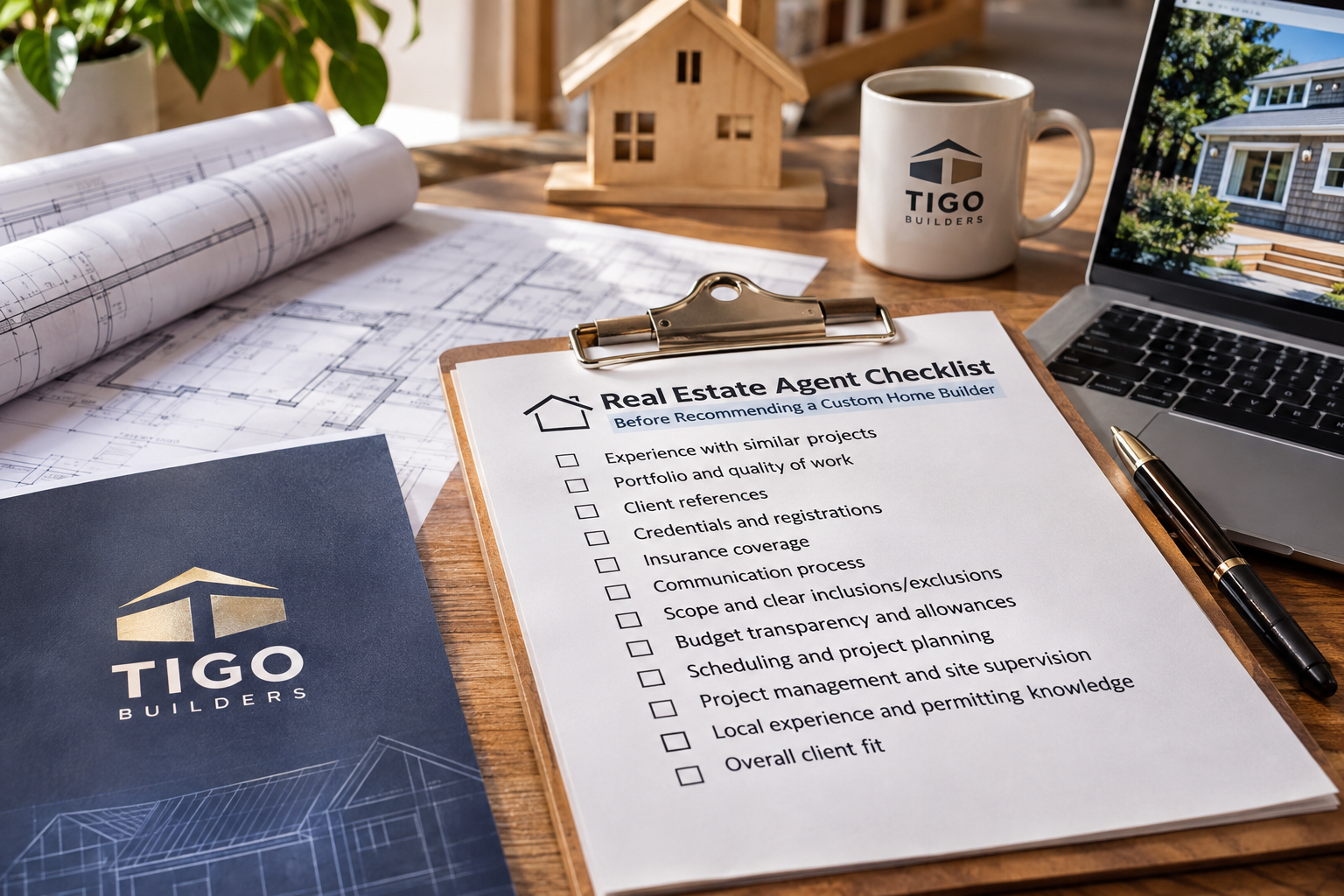
Use this checklist when comparing final candidates:
- What experience do you have with similar Custom Homes?
- Can I review comparable completed projects?
- Can you provide recent client references?
- What exactly is included in the scope?
- What is excluded?
- How was the budget developed?
- Which items are allowances?
- What assumptions remain unresolved?
- How is the construction schedule developed?
- Who will be my primary contact?
- Who supervises the project?
- How are subcontractors coordinated?
- How are materials and long-lead items tracked?
- How are changes documented and approved?
- How do you handle construction problems?
- How are required inspections coordinated?
- What is your quality-control process?
- Which credentials and insurance apply to my project?
- How is project closeout handled?
- Is there a warranty or post-completion process applicable to this project?
The precise Questions to Ask a Custom Home Builder should also reflect the design, property, ownership situation, and project complexity.
How Should You Compare Final Builder Candidates?
Compare more than price.
Look at the complete working relationship.
Evaluate:
- Relevant experience
- Scope clarity
- Communication
- Budget transparency
- Scheduling
- Organization
- References
- Quality control
- Problem-solving
- Credentials
- Project management
The strongest fit is the builder who can explain how the entire project will be managed responsibly.
Does Local Experience Matter?
It can.
A builder familiar with work in Falmouth, MA or surrounding communities may understand local processes, suppliers, inspections, construction logistics, and seasonal considerations.
However, each property remains unique.
A project in Mashpee, MA may differ from one in Bourne, MA, Sandwich, MA, or Woods Hole, MA.
Site conditions, design, permitting, and owner goals should always be reviewed individually.
Frequently Asked Questions About Choosing a Custom Home Builder
What Are the Most Important Questions to Ask a Custom Home Builder?
Ask about experience, references, project scope, budget, allowances, schedule, communication, supervision, changes, subcontractors, credentials, inspections, problem-solving, procurement, and quality control.
These topics reveal how the builder plans to manage the complete project.
How Many Builders Should I Interview?
There is no universal number.
Interview enough qualified builders to understand differences in experience, scope, communication, pricing approach, and project management.
The quality of the comparison matters more than reaching a specific number.
Should I Choose the Lowest-Priced Builder?
Not automatically.
A lower proposal may contain different scope, allowances, exclusions, assumptions, or quality expectations.
NAHB recommends caution with unusually low bids and emphasizes reviewing written scope and contracts.
Compare what each proposal actually includes.
When Should I Hire a Custom Home Builder?
Builder involvement can be useful during design and pre-construction, before every major decision is finalized.
Early input may help with budgeting, constructability, procurement, scheduling, and value engineering.
The appropriate timing depends on the project delivery approach.
Should I Ask a Builder for References?
Yes.
References can reveal how the builder communicates, manages changes, handles problems, and follows through during construction.
NAHB specifically recommends requesting previous customer references.
What Should I Ask About the Construction Timeline?
Ask how the schedule is created, which decisions affect it, which materials need early ordering, how trades are coordinated, and how schedule changes are communicated.
Avoid relying only on a promised completion date.
How Can I Tell if a Builder Communicates Well?
Pay attention before signing.
Are questions answered clearly?
Are assumptions explained?
Is important information documented?
Does the builder explain difficult topics without avoiding them?
Early communication can provide useful insight into how the working relationship may function during construction.
Conclusion: Why Do the Right Questions Matter?
The right Questions to Ask a Custom Home Builder can reduce uncertainty before a major construction commitment.
They help homeowners understand more than the final price.
Experience matters because Custom Home construction can require detailed coordination.
Communication matters because decisions continue throughout the project.
Scope clarity helps establish what is included and excluded.
Transparent pricing helps homeowners understand allowances and unresolved assumptions.
Schedule discussions reveal how the builder plans and communicates milestones.
Project management shows who will organize trades, materials, decisions, and construction activities.
Change management explains how revisions will be documented and evaluated.
Credentials and insurance should be verified based on applicable project requirements.
References provide insight into previous client experiences.
Quality control explains how workmanship is reviewed during construction.
Problem-solving shows how the builder responds when the project does not proceed exactly as expected.
Ultimately, homeowners should select a Custom Home Builder based on overall fit, organization, transparency, relevant experience, communication, and the ability to manage the project responsibly.
The cheapest builder is not automatically the best choice.
Likewise, the most expensive proposal does not automatically guarantee the best experience.
The better comparison is whether the builder’s scope, process, expectations, and project-management approach align with the homeowner’s goals.
For projects in Falmouth, MA and across Cape Cod, MA, that clarity can be especially important for second-home owners who may participate in many decisions remotely.
Tigo Builders emphasizes proactive communication, transparent budgeting, realistic scheduling, clear expectations, detailed project management, precise craftsmanship, architect-builder collaboration, quality control, and responsible problem-solving.
Contact Tigo Builders Today… to discuss the Questions to Ask a Custom Home Builder and review your architectural plans, project scope, construction budget, pre-construction planning, schedule expectations, communication, project management, quality goals, and construction execution.