Introduction
Good communication prevents many Custom Home problems by creating clear expectations around scope, budget, schedule, design decisions, material selections, field questions, documentation, change management, and quality control.
Author: Tigo Builders
Last Updated: November 12, 2026
Custom Home construction connects homeowners, architects, builders, subcontractors, suppliers, and consultants.
When information moves clearly between those people, decisions are easier to coordinate.
However, communication does not mean sending constant messages.
Good communication means the right information reaches the right person at the right time and is documented when necessary.
Why Is Communication Important in Custom Home Construction?
Custom Home Builder Communication helps turn expectations into information the project team can actually use.
A homeowner may have a clear vision, but the builder and architect need specific details to execute that vision.
The same principle applies to budget expectations, finish quality, schedule goals, and material selections.
When expectations remain unstated, each person may interpret them differently.
Those differences can eventually become construction problems.
What Should Be Communicated Before Construction Begins?
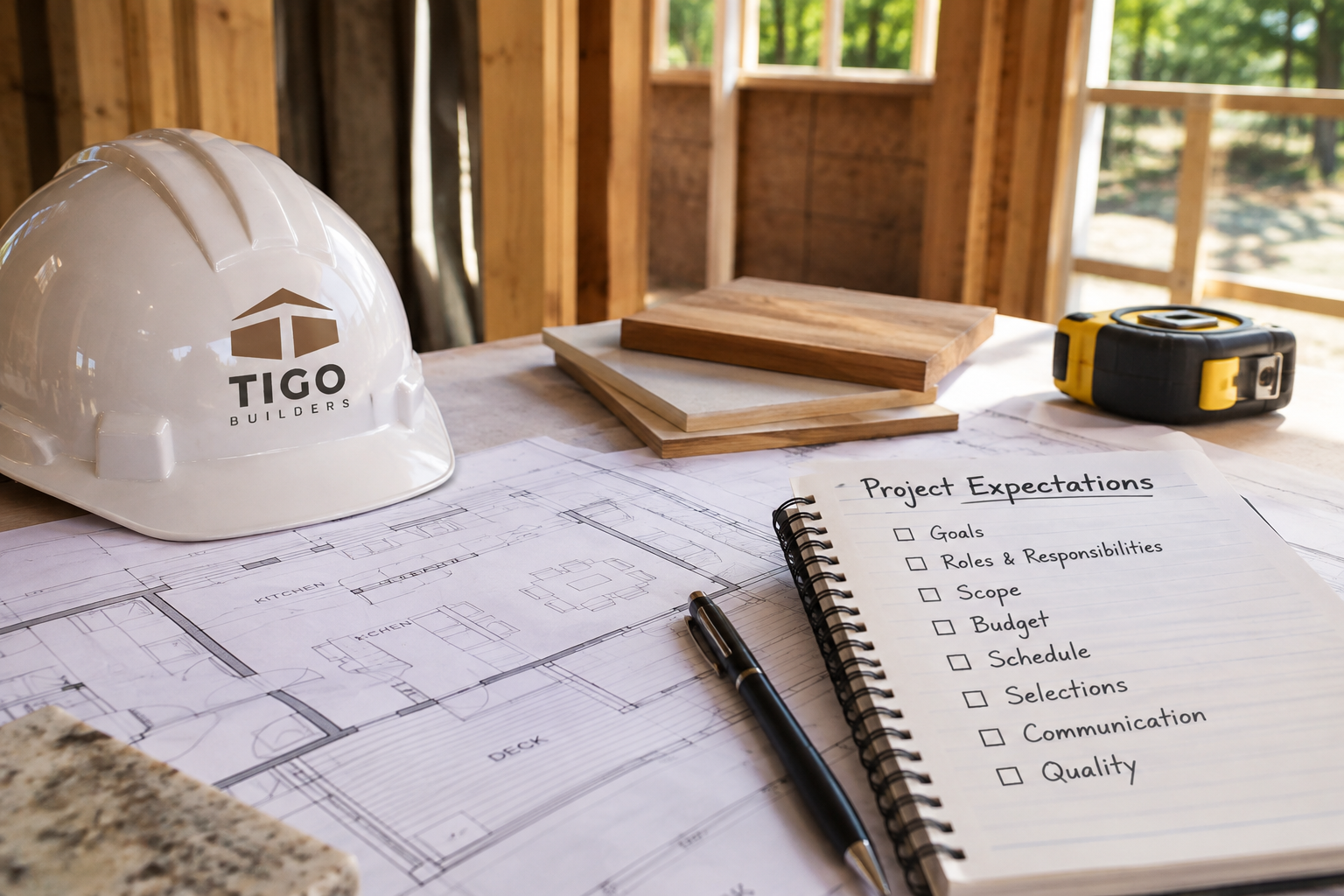
The project team should establish expectations before work becomes active.
Important topics include:
- Project goals
- Design priorities
- Scope
- Budget expectations
- Schedule goals
- Quality expectations
- Communication responsibilities
- Material selections
- Decision deadlines
- Change procedures
These conversations create a shared starting point.
They also help identify issues while the project still has greater planning flexibility.
Why Should Expectations Be Clear From the Beginning?
Homeowners, architects, and builders may use the same words while imagining different outcomes.
For example, “high-end finish” can mean different things to different people.
Specific expectations provide better direction.
Instead of assuming everyone understands the same standard, the team can discuss materials, details, examples, and responsibilities.
Consequently, uncertainty is reduced before trades begin working.
Why Should Project Roles Be Defined Clearly?
Clear roles help everyone understand who provides information and who needs to receive it.
A Custom Home project may involve the homeowner, builder, architect, engineers, designers, subcontractors, and suppliers.
Responsibilities can vary by project agreement.
Therefore, they should be discussed rather than assumed.
This article does not provide legal advice regarding contractual responsibilities.
Who Should Be Responsible for Project Communication?
There should be a clear primary communication structure.
Homeowners should know who to contact about construction questions.
Architects should know who communicates field conditions.
Builders should know who can approve homeowner selections or design decisions.
The exact structure varies, but uncertainty about communication responsibilities can create delays and duplicate instructions.
Why Is One Primary Contact Helpful?
A primary contact can organize information before it moves through the larger project team.
That does not mean all communication must pass through one person.
However, homeowners should understand who is responsible for coordinating important updates.
This can reduce situations where different team members receive conflicting instructions.
How Can Communication Prevent Scope Misunderstandings?
Clear scope communication explains what the builder is responsible for providing.
It should also identify work that is excluded, unresolved, owner-supplied, or managed by another party.
Homeowners should not assume a task or product is included simply because it appears related to the project.
The proposal and project documents should clarify responsibilities.
What Scope Information Should Homeowners Understand?
Homeowners should understand how major labor, materials, subcontractors, allowances, specialty work, exclusions, and owner-supplied items are addressed.
Unresolved selections should also be identified.
For example, a lighting allowance is different from a fully selected and priced lighting package.
Both may appear in a budget, but they represent different levels of certainty.
Why Do Allowances Require Communication?
An allowance is a budget amount for an item that has not been fully selected or priced.
The homeowner should understand what level of product that amount assumes.
Otherwise, expectations can differ significantly.
A homeowner may expect one finish level while the estimate assumes another.
Custom Home Builder Communication helps identify that difference before selections are finalized.
Why Should Exclusions Be Discussed?
An exclusion identifies work or products that are not included in a proposal.
Problems can develop when an owner assumes an excluded item is included.
Clear exclusions also help coordinate work performed by others.
For example, an owner-supplied product may still require dimensions, delivery planning, storage, and installation coordination.
How Should Budget Expectations Be Discussed?
Budget communication should explain more than the current total.
Homeowners should understand how the estimate was developed and which areas still depend on future decisions.
Useful information may include preliminary pricing, assumptions, allowances, exclusions, open selections, and possible changes.
Transparency does not guarantee that costs will never change.
Instead, it helps explain why the budget may develop as information becomes more complete.
Why Are Pricing Assumptions Important?
Early construction pricing may rely on assumptions when drawings or selections are incomplete.
Those assumptions should be visible.
For example, an estimate might assume a certain flooring level, cabinetry scope, fixture range, or construction method.
Explaining those assumptions makes the number more meaningful.
How Can Budget Communication Prevent Conflict?
Unexpected numbers often create more concern when homeowners do not understand where they came from.
Early communication provides context.
If a selection differs from an allowance, the homeowner can understand the financial effect before the decision becomes permanent.
Likewise, scope changes can be discussed in relation to the original project assumptions.
What Does NAHB Recommend About Builder Communication?
NAHB advises homeowners to consider whether they can communicate easily with a builder because the relationship continues throughout construction.
It also recommends clear written agreements that define the work.
These principles reinforce the importance of communication before the project becomes complex.
Custom Home Builder Communication begins during builder selection, not after construction starts.
How Can Communication Protect the Construction Schedule?
Schedule communication connects project milestones with the decisions required to reach them.
Homeowners should understand that some activities depend on selections, approvals, procurement, and previous trade work.
A useful construction schedule is not only a completion date.
It also explains important dependencies.
What Should Homeowners Know About Schedule Milestones?
Homeowners should understand when major decisions may be needed.
For example, cabinetry information may be required before certain electrical or plumbing work is finalized.
Window decisions may affect openings and exterior details.
The exact sequence varies by project.
Therefore, the builder should explain project-specific deadlines rather than rely on universal timelines.
Why Do Selection Deadlines Matter?
A product must usually be selected before it can be priced, ordered, fabricated, delivered, and installed.
Some decisions also influence work performed by other trades.
A late decision does not automatically create a delay.
However, the builder should explain when delaying a decision may affect procurement or construction sequencing.
How Should Schedule Changes Be Communicated?
Schedule changes should include useful context.
Homeowners should understand what changed, why it changed, and whether a decision is required from them.
The builder should also consider which trades, suppliers, or design professionals are affected.
That information helps the team respond rather than simply react.
Why Is Communication About Design Intent Important?
A drawing communicates technical information, but architectural details also represent design priorities.
The builder should understand which relationships are important.
These may include proportions, alignments, sightlines, cabinetry, millwork, trim, lighting, material transitions, and exterior details.
When something is unclear, asking is usually better than guessing.
How Can Architect-Builder Communication Prevent Problems?
The architect and builder bring different expertise to a Custom Home.
The architect develops and protects design intent.
The builder brings construction knowledge, field coordination, sequencing, procurement, and trade management.
A strong communication process connects those roles.
It allows practical construction information to inform decisions without replacing the architect’s design responsibilities.
What Does AIA Say About Architect-Contractor Communication?
In May 2026, AIA and AGC released a collaboration framework emphasizing early alignment, clear roles, open communication, contractor engagement during design, and structured change management.
The framework also highlights constructability and proactive risk management.
These principles apply well to Custom Home Builder Communication, where small coordination decisions can affect several trades.
How Should Design Questions Be Submitted?
The process should be clear before the questions become urgent.
Depending on the project, a field question may include a drawing reference, photo, measurement, product detail, or description of the condition.
The builder should provide enough information for the architect or appropriate professional to understand the issue.
Important responses should then reach affected trades.
Why Should Builders Avoid Guessing About Design Details?
A small assumption can affect several areas of construction.
For example, changing a cabinet dimension may influence electrical locations, plumbing, countertops, appliances, or adjacent finishes.
An early question may take minutes to clarify.
Correcting completed work can require considerably more coordination.
Therefore, questions should be viewed as part of good project management rather than as a weakness.
How Can Early Communication Improve Constructability?
Constructability means considering how the design will practically be built.
Early builder input may identify sequencing, fabrication, installation, access, or material concerns.
Those issues can then be discussed while the design has more flexibility.
The architect remains responsible for design decisions defined by the project agreement.
The builder contributes practical construction information.
How Should Material Selections Be Communicated?
Material communication should be specific enough to support purchasing and installation.
Useful information may include the product, finish, dimensions, availability, installation requirements, and approval status.
A vague description can create multiple interpretations.
For example, naming only a general material category may not provide enough information for ordering or field coordination.
Why Do Product Dimensions Matter?
Different products can require different rough openings, connections, clearances, or installation methods.
Therefore, the selection itself may influence surrounding construction.
This can apply to appliances, fixtures, cabinetry, doors, hardware, lighting, and many other products.
Accurate product information helps trades prepare correctly.
Why Should Material Availability Be Communicated?
A selected material may not always be available when the project needs it.
Supplier information can change.
Therefore, actual availability and lead times should be verified during procurement.
If a product creates a scheduling concern, the homeowner and design team should receive that information early enough to evaluate options.
How Should Substitutions Be Discussed?
A substitution should not happen simply because another product is available.
The team may need to compare appearance, dimensions, compatibility, performance, installation, cost, availability, and design intent.
The appropriate decision-maker should receive enough information to evaluate the alternative.
Clear communication helps prevent an apparently simple product change from creating a later coordination issue.
Why Should Important Design Decisions Be Documented?
Construction projects involve many conversations.
Without documentation, people may remember decisions differently.
Important approvals, selections, clarifications, and changes should leave a usable record when appropriate.
AIA has noted that fragmented communication across different channels can increase coordination risk during construction.
Organized documentation helps create a shared reference for the project team.
Does Every Conversation Need Formal Documentation?
No.
Not every routine discussion needs a formal record.
The key is recognizing which decisions affect scope, cost, schedule, design, procurement, or construction execution.
Those decisions are more valuable when they can be referenced later.
Good communication should be organized without becoming unnecessarily complicated.
How Often Should Homeowners Receive Project Updates?
There is no universal frequency that fits every Custom Home.
The builder and homeowner should establish expectations before construction.
Updates may occur through written summaries, meetings, progress photos, project-management platforms, or other agreed methods.
Consistency matters more than using one specific communication tool.
What Should a Useful Project Update Include?
A useful update should focus on information the homeowner needs to understand or act on.
That may include current progress, upcoming work, decisions needed, selections, schedule changes, budget items, or open questions.
Updates should help owners understand what is happening rather than overwhelm them with every minor job-site detail.
Why Is Communication Especially Important for Second-Home Owners?
Second-home owners may spend much of the construction period away from the property.
They may depend more heavily on written information and progress documentation.
Progress photos can show visible work.
However, photos alone do not explain decisions.
Schedule information, selection approvals, budget updates, and documented changes can provide the missing context.
How Can Remote Owners Make Decisions More Efficiently?
Decision requests should be specific.
Instead of asking a homeowner to “choose the bathroom,” the team can identify exactly which material, finish, dimension, or approval is needed.
The request should also explain when the decision is required.
This makes remote communication more actionable.
How Does Local Project Context Affect Communication?
Local conditions can create additional coordination needs.
Permitting, inspections, site access, seasonal goals, existing structures, and project logistics can influence communication.
However, each property is different.
A project in Falmouth, MA may require different planning from one in Mashpee, MA, Bourne, MA, Sandwich, MA, or Woods Hole, MA.
Regional experience should support project-specific communication.
How Can Permitting and Inspections Affect Communication?
Required approvals and inspections create coordination points within construction.
The Town of Falmouth, MA lists several inspection stages for applicable new construction and addition or alteration projects.
The required sequence should always be confirmed for the specific project.
The project team should understand when work must be ready and whether an inspection affects upcoming construction activities.
Can Communication Improve Quality Control?
Yes.
Quality expectations must be understood before they can be consistently executed.
The builder should communicate approved materials, important details, design priorities, and corrective instructions to the people performing the work.
Quality control is not only about discovering defects.
It is also about preventing misunderstandings before work is completed.
Why Should Quality Expectations Be Discussed Early?
Terms such as “clean finish” or “high quality” can be subjective.
Specific drawings, approved samples, mockups when appropriate, and clear installation expectations provide better guidance.
The builder can then review completed work against known expectations rather than vague assumptions.
How Does Tigo Builders Approach Project Communication?
Tigo Builders emphasizes proactive communication, clear expectations, transparent budgeting, realistic scheduling, architect-builder collaboration, detailed project management, quality control, and responsible problem-solving.
For projects across Cape Cod, MA, that approach is particularly useful when homeowners are managing construction from another location.
Custom Home Builder Communication should make the project easier to understand, not more complicated.
Clear expectations, defined roles, scope discussions, budget information, scheduling, selections, and documented decisions create a strong foundation.
However, the communication process becomes even more important once active construction creates field questions.
The next stage involves RFIs, change orders, unexpected conditions, subcontractor coordination, inspections, schedule changes, budget changes, corrective work, and conflict resolution.
How those issues are communicated can determine whether a problem is addressed early or becomes more difficult to resolve.
How Should Field Questions Be Communicated?
Field questions should be raised before uncertainty becomes permanent construction.
The builder should first identify the issue and gather enough information for the appropriate professional to understand it.
Useful information may include:
- Drawing references
- Photos
- Measurements
- Product information
- Affected trades
- Schedule considerations
The builder should then track the response and communicate the final direction to everyone whose work is affected.
This is a critical part of Custom Home Builder Communication.
Does Every Field Question Need a Formal Process?
No.
Some routine questions can be resolved through normal project communication.
However, decisions affecting design, cost, schedule, materials, or several trades should be clear and documented when appropriate.
The goal is not unnecessary paperwork.
The goal is preventing important information from being lost.
What Is an RFI in Custom Home Construction?
An RFI, or Request for Information, is a structured request for clarification when project information is unclear.
Not every residential project requires a formal RFI system.
However, the concept can help organize important field questions.
A useful request may include the drawing reference, photos, dimensions, issue description, affected trades, and relevant schedule information.
How Can RFIs Reduce Misunderstandings?
A structured question gives the architect or other professional the information needed to evaluate the condition.
The response can then become a clear reference for the builder and affected trades.
AIA has highlighted how fragmented construction communication can increase coordination risk when important information is spread across multiple channels.
Therefore, organized communication can make project decisions easier to track.
Why Should Builders Avoid Guessing?
Guessing can turn a small uncertainty into completed work that does not match the intended design.
An assumption about dimensions may affect cabinetry.
A framing decision may affect electrical or plumbing work.
A finish change may affect material transitions.
Therefore, asking early can be more efficient than correcting several connected scopes later.
How Can Communication Protect Design Intent?
Design intent depends on more than individual products.
It may involve:
- Proportions
- Alignments
- Sightlines
- Cabinetry
- Millwork
- Lighting
- Trim
- Material transitions
When a detail is unclear, the builder should communicate with the architect rather than make an unauthorized design assumption.
The builder contributes construction knowledge while the architect protects design responsibilities defined for the project.
How Should Change Orders Be Discussed?
Change orders should clearly explain what is changing and why.
Homeowners should also understand potential effects on:
- Cost
- Schedule
- Materials
- Labor
- Procurement
- Subcontractors
- Completed work
Whenever practical, proposed changes should be reviewed and documented before affected work proceeds.
Custom Home Builder Communication is especially important when one decision changes several parts of the project.
Why Should Cost and Schedule Impacts Be Discussed Together?
A change can affect more than purchase price.
For example, changing a product may require different fabrication, installation, trade coordination, or delivery timing.
Therefore, the homeowner should understand the broader project impact.
The 2026 AIA-AGC collaboration framework emphasizes clear communication, defined roles, proactive risk management, and structured change management.
Those principles can also support Custom Home construction.
How Should Budget Changes Be Communicated?
Budget changes should come with an explanation.
A homeowner should understand what caused the difference and which project decision it relates to.
Potential reasons include:
- Revised selections
- Allowance differences
- Substitutions
- Unexpected conditions
- Scope changes
- Owner-requested changes
Transparent communication allows homeowners to make decisions with more context.
Why Are Allowance Updates Important?
An allowance begins as an estimated amount.
Once a product is selected, the actual cost can be compared with that original assumption.
If there is a difference, homeowners should understand it before the financial impact becomes unclear.
This makes allowance tracking an important part of Custom Home Builder Communication.
How Should Schedule Changes Be Communicated?
A schedule update should explain more than a new date.
The builder should communicate:
- What changed
- Why it changed
- Which activities are affected
- Whether a homeowner decision is needed
- Whether procurement is affected
- What the new planning assumptions are
Not every delay can be prevented.
However, early communication gives the team more time to respond.
Why Should Subcontractors Receive Updated Information?
A decision is not complete until the people responsible for executing it receive the correct information.
Custom Home construction involves connected trades.
For example:
- Framing changes can affect electrical work.
- Cabinetry changes can affect plumbing.
- Lighting changes can affect millwork.
- Flooring changes can affect transitions.
- Appliance changes can affect cabinetry.
The builder should coordinate those connections.
What Happens When Trades Work From Different Information?
Conflicting information can lead to rework, incorrect installations, or field questions.
Therefore, drawings, clarifications, selections, and approved changes should reach the relevant trades.
Good Custom Home Builder Communication connects decisions with execution.
It should not end when the homeowner says “approved.”
How Should Unexpected Conditions Be Communicated?
Unexpected conditions should first be documented and understood.
A practical process may include:
- Identify the condition
- Take photos or measurements
- Review project information
- Notify appropriate people
- Involve the architect or engineer when needed
- Compare solutions
- Review cost impact
- Review schedule impact
- Document the decision
- Verify corrective work
The exact process depends on the project.
Why Should Problems Be Communicated Early?
Delaying difficult information rarely makes the underlying condition easier to solve.
Early communication allows the team to evaluate options before surrounding construction progresses.
It can also give architects, consultants, trades, and homeowners more time to respond.
Good communication does not mean pretending problems never happen.
It means addressing them responsibly when they do.
How Does Communication Support Required Inspections?
The builder should understand what work must be ready and how inspections fit within construction sequencing.
For applicable new construction and addition or alteration projects, the Town of Falmouth, MA lists stages such as foundation, rough trades, framing, insulation, and final inspections.
Requirements should always be confirmed for the specific project.
Are Inspections the Same as Quality Control?
No.
Required inspections and the builder’s internal quality-control process serve different purposes.
A municipal inspection may focus on applicable code requirements.
The builder should also review project-specific workmanship, materials, details, and design expectations.
Communication helps connect both processes with the construction schedule.
How Can Communication Improve Quality Control?
Quality expectations must reach the people performing the work.
Useful information may include:
- Approved materials
- Drawings
- Details
- Samples
- Mockups where appropriate
- Corrective instructions
- Punch-list items
A worker cannot reliably execute an expectation that was never communicated clearly.
Therefore, quality control begins before the final inspection or punch list.
How Should Corrective Work Be Communicated?
Corrective work should identify the issue, required correction, responsible trade, and verification process.
The project team should also know if the correction affects surrounding work.
Once completed, the builder should verify that the agreed solution was implemented.
Closing the communication loop prevents unresolved issues from simply disappearing from discussion.
How Can Communication Reduce Conflict?
Clear communication can reduce tension by keeping discussions focused on facts.
When a disagreement occurs, the team can:
- Document the condition
- Review project documents
- Clarify responsibilities
- Evaluate options
- Review cost impacts
- Review schedule impacts
- Confirm the decision
This does not replace legal advice when a contractual dispute requires it.
However, organized communication can prevent many disagreements from becoming more confusing.
Does Good Communication Mean Avoiding Difficult Conversations?
No.
Effective communication includes discussing problems, cost changes, schedule concerns, and mistakes professionally.
Avoiding those topics can create larger misunderstandings.
Strong Custom Home Builder Communication should make difficult information easier to understand, not hide it.
What Communication Warning Signs Should Homeowners Watch for During Custom Home Construction?
Certain patterns may indicate that the communication process needs attention.
- Unanswered questions: Important issues remain unresolved.
- Inconsistent updates: Homeowners do not know when information will arrive.
- Verbal-only decisions: Major choices have no clear written record.
- Unclear responsibilities: Team members give different answers about who decides.
- Unexplained schedule changes: Dates move without context.
- Undocumented budget changes: New costs appear without supporting information.
- Conflicting information: Different team members communicate different directions.
- Outdated trade information: Subcontractors work from superseded decisions.
- Late problem reporting: Significant issues are shared only after work progresses.
- Unclear change orders: The homeowner cannot understand what changed.
- Limited remote visibility: Second-home owners receive little meaningful progress information.
No single issue automatically proves that a project is poorly managed.
However, repeated communication gaps deserve attention.
What Should Be Included in a Custom Home Builder Communication Checklist?
A practical communication checklist should cover:
- Primary project contact
- Communication frequency
- Progress updates
- Progress photos
- Budget updates
- Schedule updates
- Decision deadlines
- Material selections
- Approval tracking
- Design questions
- RFI process where appropriate
- Architect coordination
- Subcontractor communication
- Change orders
- Unexpected conditions
- Inspection coordination
- Quality-control issues
- Corrective work
- Decision documentation
- Project closeout
The exact process can be customized to the project.
The important goal is that everyone understands how essential information will move through the team.
Why Is Communication Especially Important for Remote Homeowners?
Second-home owners may be hundreds of miles from the construction site.
They often depend on structured information rather than frequent in-person visits.
Written updates, photos, approvals, schedule information, and documented changes can help them remain involved.
This can be especially valuable for projects across Cape Cod, MA where owners may use the property seasonally.
Does Local Experience Replace Communication?
No.
Local knowledge can help with permitting, suppliers, inspections, logistics, and seasonal planning.
However, every property remains different.
A project in Falmouth, MA may require different coordination from one in Mashpee, MA, Bourne, MA, Sandwich, MA, or Woods Hole, MA.
Project-specific communication remains essential.
Frequently Asked Questions About Custom Home Builder Communication
Why Is Custom Home Builder Communication Important?
It helps homeowners, architects, builders, and trades maintain shared expectations about scope, budget, schedule, design, selections, changes, and quality.
Clear communication can identify misunderstandings before they become completed construction.
How Often Should a Builder Communicate With Homeowners?
There is no universal frequency.
The builder and homeowner should establish an update process that fits the project.
Consistency matters more than using a specific schedule or platform.
What Information Should a Construction Update Include?
A useful update may cover completed work, upcoming activities, decisions needed, material selections, schedule changes, budget items, and open questions.
The update should help the homeowner understand both progress and required action.
How Should Design Questions Be Handled During Construction?
The builder should gather useful field information and communicate the question to the appropriate design professional.
Important responses should be documented when appropriate and shared with affected trades.
How Should Schedule Changes Be Communicated?
Homeowners should understand what changed, why it changed, which activities are affected, and whether they need to make a decision.
Updated planning assumptions should also be explained.
How Can Communication Prevent Change-Order Problems?
The team should clearly explain what is changing, why the change is proposed, and how it may affect cost, schedule, materials, and labor.
Whenever practical, that information should be reviewed before affected work proceeds.
How Can Second-Home Owners Stay Informed During Construction?
They can establish a communication process that includes written updates, progress photos, budget information, schedule updates, selection approvals, and documented changes.
The system should be agreed upon before important decisions become urgent.
Conclusion: How Can Good Communication Prevent Construction Problems?
Good communication cannot eliminate every unexpected condition in Custom Home construction.
However, it can help the team recognize issues earlier, understand them more clearly, and make better-informed decisions.
Scope communication establishes what is included.
Role clarity defines who is responsible for decisions and coordination.
Budget communication explains financial changes.
Schedule communication helps connect selections, procurement, inspections, and trades.
Clear material information supports accurate ordering and installation.
Architect-builder communication helps protect design intent.
Field questions reduce the need for assumptions.
Change documentation keeps homeowners informed when the project evolves.
Inspection communication supports construction sequencing.
Quality-control communication explains what workers and subcontractors are expected to deliver.
Documentation creates a shared record when multiple people are involved.
Ultimately, Custom Home Builder Communication is not about sending the greatest number of messages.
It is about providing useful information at the right time and making important decisions clear.
Homeowners should look for a Custom Home Builder who can communicate openly, document important decisions, coordinate professionals and trades, and address problems responsibly.
Tigo Builders emphasizes proactive communication, clear expectations, transparent budgeting, realistic scheduling, architect-builder collaboration, detailed project management, precise craftsmanship, quality control, and documented decision-making.
Contact Tigo Builders Today… to discuss how Custom Home Builder Communication can support your architectural plans, project scope, pre-construction planning, construction budget, schedule, material selections, quality expectations, project management, and construction execution.