Introduction
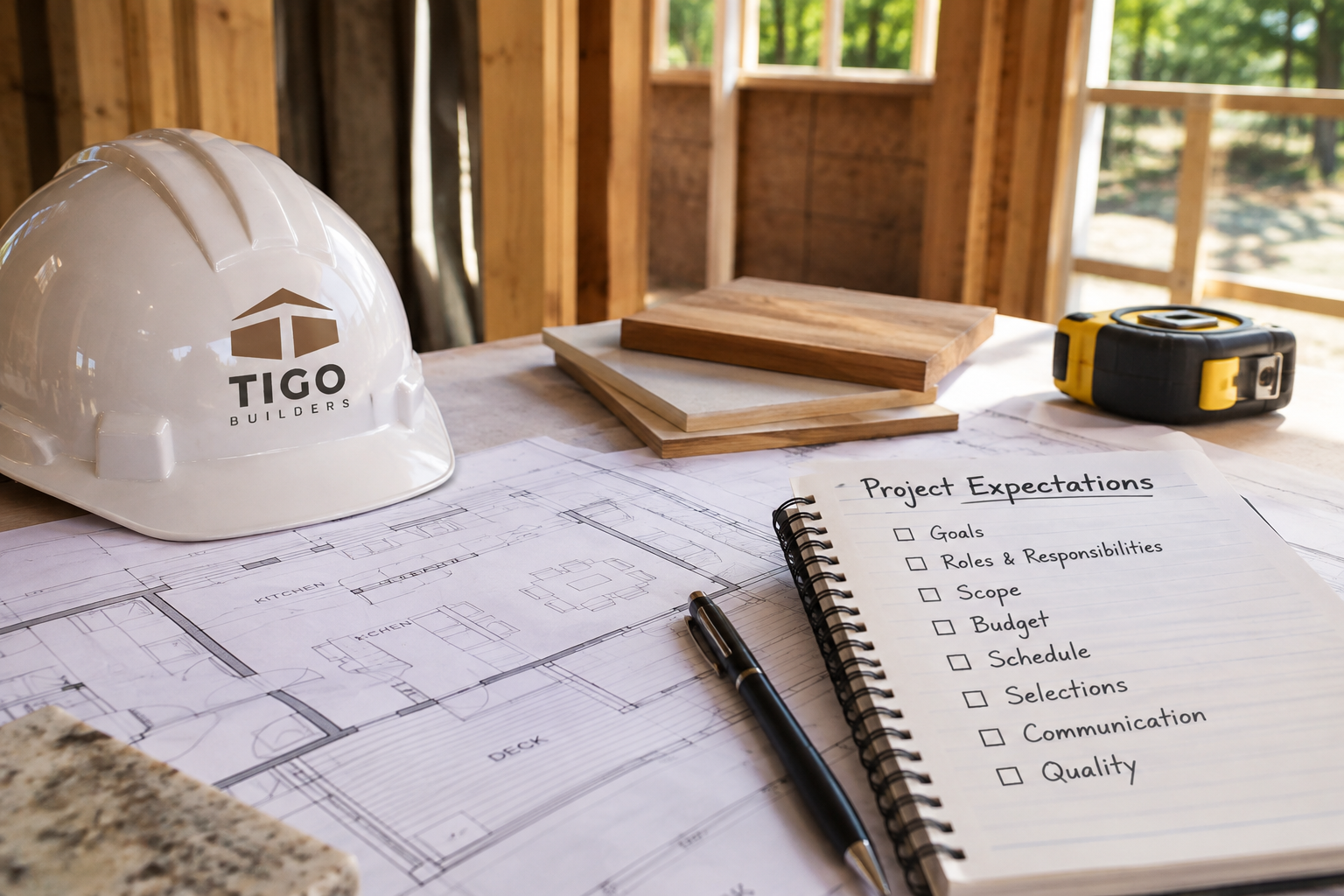
Clear Custom Home Project Expectations align project goals, roles, responsibilities, scope, budget, schedule, communication, design intent, selections, decisions, documentation, and quality standards before construction begins.
Author: Tigo Builders
Last Updated: November 20, 2026
A Custom Home brings together people with different responsibilities and expertise.
The homeowner understands how the home should support daily life.
The architect develops the design.
Meanwhile, the builder turns that information into coordinated construction.
Problems can develop when those three perspectives are not aligned early.
Why Are Clear Expectations Important in a Custom Home Project?
Clear expectations give the homeowner, architect, and builder a shared framework for decisions.
They help define what the project is trying to achieve and how the team will work together.
Custom Home Project Expectations should clarify more than the final appearance of the house.
They should also address:
- Project goals
- Responsibilities
- Scope
- Budget
- Schedule
- Design priorities
- Quality
- Selections
- Communication
- Documentation
Clear expectations do not eliminate every unknown.
However, they can make uncertainty easier to manage.
What Should Be Agreed on Before Construction Begins?
The team should first agree on the overall project vision and the process for reaching it.
That includes both design goals and practical construction expectations.
Important topics may include:
- How the home should function
- Important architectural features
- Budget priorities
- Quality expectations
- Seasonal goals
- Decision responsibilities
- Communication preferences
These discussions help the project team understand what deserves the greatest attention.
Why Should the Project Vision Be Defined First?
A homeowner may describe a project as comfortable, timeless, high-end, or easy to maintain.
Those ideas are useful, but they can mean different things to different people.
The team should translate broad goals into clearer priorities.
For example, a homeowner may value large gathering areas, durable finishes, natural light, or low-maintenance exterior materials.
Those priorities can influence both architecture and construction planning.
What Lifestyle Questions Should Homeowners Consider?
The home should respond to how the owner actually plans to use it.
Questions may include:
- Who will use the home?
- How often will guests stay?
- Which spaces matter most?
- Is the property seasonal?
- Is easy maintenance important?
- Are aging-in-place features a priority?
These answers give the architect and builder useful context.
How Can Long-Term Goals Affect the Project?
A decision that works today should also make sense for the expected use of the property.
Some owners may prioritize entertaining.
Others may want easier maintenance or flexible spaces for visiting family.
Therefore, Custom Home Project Expectations should include both immediate goals and long-term use.
Why Should Roles and Responsibilities Be Defined Early?
Clear roles help prevent duplicated work, missing information, and conflicting instructions.
The homeowner, architect, builder, engineers, designers, consultants, and subcontractors may all contribute differently.
Actual responsibilities depend on each project agreement.
Therefore, assumptions should not replace written project responsibilities.
This article does not provide legal advice about contractual obligations.
What Should the Homeowner Be Responsible For?
The homeowner should understand where timely input is needed.
Depending on the project, responsibilities may include:
- Communicating priorities
- Reviewing information
- Approving selections
- Making decisions
- Responding by agreed deadlines
- Communicating requested changes
- Reviewing budget updates
Homeowners generally should not need to manage individual subcontractors directly.
The builder should coordinate construction activities according to the project structure.
Why Does Timely Homeowner Input Matter?
Construction decisions are connected.
A delayed appliance selection may affect cabinetry or electrical planning.
A late plumbing fixture decision may affect rough-in information.
However, not every delayed decision automatically causes a construction delay.
The builder should explain which decisions are time-sensitive and why.
What Should the Architect Be Responsible For?
The architect’s services depend on the agreement.
Those services may include:
- Design development
- Construction documents
- Design intent
- Clarifications
- Consultant coordination
- Material guidance
- Review of appropriate field questions
Architects may also help evaluate whether proposed changes remain consistent with the design.
The exact role should be understood before construction begins.
Why Is the Architect’s Role Important During Construction?
Construction can reveal conditions or questions that require design interpretation.
The builder may identify the issue.
However, questions affecting architectural design may require architect input.
AIA guidance emphasizes that owners should communicate functional needs, design preferences, budget concerns, and timely feedback to support the design process.
That communication remains valuable as the project moves toward construction.
What Should the Builder Be Responsible For?
The builder generally brings construction expertise to the team.
Depending on the project structure, that may include:
- Pre-construction planning
- Budgeting
- Constructability
- Procurement
- Scheduling
- Trade coordination
- Site supervision
- Quality control
- Project communication
The builder should contribute practical information without replacing the architect’s design role.
Why Does Early Builder Involvement Help?
Early builder involvement can connect architectural decisions with current construction realities.
The builder may identify issues involving materials, fabrication, sequencing, procurement, or trade coordination.
A 2026 AIA-AGC framework emphasizes early alignment, shared goals, clear roles, open communication, and contractor involvement during design.
It also highlights constructability and cost certainty as important collaboration goals.
These principles can support stronger Custom Home Project Expectations before work reaches the field.
How Should Project Scope Be Defined?
Scope should explain what work the builder is expected to provide.
Important categories may include:
- Labor
- Materials
- Subcontractors
- Specialty work
- Allowances
- Owner-supplied items
- Exclusions
- Incomplete selections
The scope should also identify major assumptions where information is still developing.
Why Can Unclear Scope Create Problems?
A homeowner may assume something is included because it appears on a drawing or was discussed during a meeting.
The builder may have priced the project differently.
That gap can create budget and responsibility conflicts.
Therefore, written scope clarification is more reliable than assumptions.
NAHB recommends complete, clearly written contracts and emphasizes the importance of communication throughout the construction process.
How Do Allowances Affect Project Expectations?
An allowance is a budget amount for an item that has not yet been fully selected or priced.
It may apply to categories such as tile, lighting, plumbing fixtures, appliances, flooring, or hardware.
The homeowner should understand what quality level the allowance assumes.
Otherwise, a later selection may differ substantially from the original budget expectation.
Why Should Exclusions Be Discussed Clearly?
An exclusion identifies something that is not included in the builder’s scope or price.
The project team should understand exclusions before construction begins.
An excluded item may still require coordination.
For example, an owner-purchased product may require delivery planning, dimensions, storage, or installation information.
How Should Budget Expectations Be Discussed?
Budget discussions should connect numbers with scope and design decisions.
A preliminary estimate may include:
- Pricing assumptions
- Allowances
- Exclusions
- Selected materials
- Unresolved items
- Specialty work
- Design priorities
A construction budget may evolve as drawings, selections, engineering, and trade pricing become more complete.
That evolution should be communicated clearly.
Why Should Budget Priorities Be Established Early?
Not every feature carries equal importance to the homeowner.
One owner may prioritize custom millwork.
Another may value the kitchen, outdoor living, or energy performance more.
Identifying priorities helps the architect and builder understand where the homeowner wants to protect investment.
Other areas can then be evaluated more flexibly if budget adjustments become necessary.
Does Value Engineering Mean Reducing Quality?
Not necessarily.
Value engineering should examine whether the project can achieve important goals more efficiently.
That may involve reviewing materials, detailing, fabrication, labor, or construction methods.
The objective should be protecting value rather than automatically selecting the cheapest option.
The architect and builder should evaluate alternatives together when design intent may be affected.
How Should Schedule Expectations Be Established?
Schedule expectations should include more than a desired completion date.
A realistic schedule depends on many connected activities.
These may include:
- Pre-construction planning
- Permitting
- Material selections
- Procurement
- Fabrication
- Trade sequencing
- Inspections
- Design clarifications
- Owner decisions
The builder should explain these dependencies before presenting schedule expectations as firm.
Why Do Selection Deadlines Matter?
Some products need to be selected well before installation.
Cabinetry may require design approval and fabrication.
Windows and doors may affect rough openings.
Fixtures can influence plumbing or electrical coordination.
Therefore, the homeowner should understand which decisions need earlier attention.
Actual lead times should be verified with current suppliers.
How Can Permits and Inspections Affect Expectations?
Permits and required inspections are part of construction planning.
The exact requirements depend on the project and jurisdiction.
For applicable new construction and additions or alterations, the Town of Falmouth, MA lists inspections such as foundation, rough trades, framing, insulation, and final stages.
The specific inspection sequence should always be confirmed for the project.
Why Should Seasonal Goals Be Discussed Early?
Some homeowners want work completed before an important seasonal period.
That goal can influence planning, selections, procurement, and trade sequencing.
However, a seasonal goal should not be treated as a guaranteed completion date without project-specific planning.
Custom Home Project Expectations should distinguish between an important goal and a schedule supported by actual project information.
How Should Design Intent Be Communicated?
The homeowner, architect, and builder should understand which architectural relationships are especially important.
These may include:
- Proportions
- Alignments
- Sightlines
- Material transitions
- Cabinetry
- Millwork
- Trim
- Lighting
- Exterior details
Understanding why a detail matters can improve field decisions.
What Happens When Design Intent Is Not Clear?
A builder may see several technically possible ways to construct a condition.
However, those options may not produce the same architectural result.
When design intent is unclear, the builder should ask rather than guess.
This allows the architect to clarify the goal before an assumption becomes permanent work.
How Should Quality Expectations Be Defined?
Terms such as “high quality” or “premium finish” are subjective.
They should be supported by more specific information.
That may include:
- Approved materials
- Drawings
- Detail expectations
- Samples
- Mockups where appropriate
- Finish standards
- Quality-control checkpoints
Specific expectations give the builder and trades something more useful to evaluate.
Why Should Quality Be Discussed Before the Punch List?
Quality control should occur throughout construction.
Some work becomes difficult to inspect after later materials are installed.
For example, framing dimensions may influence cabinetry or finish alignment.
Therefore, quality expectations should guide the work before the project reaches final closeout.
How Should Material Selections Be Managed?
The team should understand who selects, approves, orders, and coordinates each important material or product.
Useful information may include:
- Manufacturer or product
- Finish
- Dimensions
- Approval status
- Ordering responsibility
- Availability
- Installation requirements
Vague selections can create multiple interpretations.
Specific information supports better procurement and trade coordination.
Why Can Material Decisions Affect Both Budget and Schedule?
A product affects more than purchase price.
It may influence fabrication, labor, preparation, shipping, installation, and other trades.
Availability can also change.
Therefore, selection decisions should be coordinated with both budget and scheduling expectations.
How Should Decision Deadlines Be Established?
The builder should explain when critical information is needed and why.
A useful deadline connects the decision to construction.
For example, the team may explain that a fixture must be selected before rough-in information is finalized.
This makes the deadline easier for the homeowner to understand and prioritize.
What Happens When a Decision Is Delayed?
The impact depends on the project.
A late decision may affect procurement, fabrication, sequencing, or installation.
However, it may also be possible to absorb the delay without changing the overall schedule.
The builder should evaluate the actual effect rather than applying a universal assumption.
How Should Communication Expectations Be Defined?
The team should decide how important information will be shared.
Custom Home Project Expectations may include:
- Primary contacts
- Update frequency
- Meetings
- Written summaries
- Progress photos
- Urgent communication
- Decision documentation
- Schedule updates
- Budget updates
Good communication does not require constant messaging.
It requires useful information reaching the appropriate person when it is needed.
Why Is a Primary Contact Important?
Projects can become confusing when several people issue separate directions.
A clear primary contact helps organize information.
The homeowner should know who handles construction questions.
The architect should know who communicates field conditions.
The builder should know who has authority to approve key owner decisions.
How Can Written Documentation Reduce Misunderstandings?
Important decisions may be discussed in meetings, calls, emails, or on-site conversations.
A written record creates a shared reference.
Documentation can be especially useful for selections, design clarifications, budget changes, schedule decisions, and scope changes.
The goal is not documenting every conversation.
It is documenting information that may affect the project later.
Why Is Remote Ownership Important to Expectation Setting?
Many second-home owners may spend part of construction away from Cape Cod, MA.
That makes organized communication more important.
Useful tools may include:
- Written progress updates
- Progress photos
- Selection approvals
- Decision tracking
- Budget updates
- Schedule information
The exact communication system can vary.
Consistency and clarity matter more than one specific platform.
How Does Local Project Context Affect Expectations?
A project in Falmouth, MA may have different site, permitting, logistical, or existing-building conditions from one in Mashpee, MA.
Likewise, projects in Bourne, MA, Sandwich, MA, or Woods Hole, MA may have different requirements and goals.
Therefore, regional experience should support project-specific planning rather than replace it.
Not every property in Cape Cod, MA should be treated as having the same construction conditions.
How Does Tigo Builders Approach Clear Expectations?
Tigo Builders emphasizes clear expectations, proactive communication, transparent budgeting, realistic scheduling, architect-builder collaboration, precise craftsmanship, quality control, and detailed project management.
The goal is to establish a shared understanding before construction decisions become urgent.
Custom Home Project Expectations should begin with project vision, roles, scope, budget, schedule, design intent, quality, selections, and communication.
However, expectations must continue to be managed once construction begins.
Field questions, material substitutions, change orders, unexpected conditions, inspections, budget updates, and schedule changes can introduce new decisions.
The next stage is understanding how the homeowner, architect, and builder should respond when those conditions change the original plan.
How Should Changes Be Handled During Construction?
Changes should follow a clear process so the homeowner, architect, builder, and affected trades understand what is different from the original plan.
A change should clarify:
- What is changing
- Why it is changing
- Who needs to approve it
- Budget impact
- Schedule impact
- Material impact
- Design impact
- Trade impact
Whenever practical, proposed changes should be reviewed and documented before affected work proceeds.
This helps maintain Custom Home Project Expectations as the project evolves.
Why Should Changes Be Documented?
A verbal conversation may be useful for discussing options, but important project changes should leave a clear record.
Documentation helps the team understand the approved direction later.
It can also identify whether a change affects cost, schedule, selections, procurement, or design intent.
The exact contractual responsibility depends on the project agreement.
How Should Field Questions Be Communicated?
Field questions should be raised before uncertainty becomes permanent construction.
The builder should first identify the condition and gather useful information.
That may include:
- Photos
- Measurements
- Drawing references
- Material information
- Affected trades
- Schedule considerations
The appropriate architect, engineer, designer, or consultant can then review the issue when their input is required.
Why Should Builders Avoid Guessing?
A construction assumption can affect several connected scopes.
A framing decision may influence electrical work.
Cabinetry may affect plumbing.
Lighting may affect millwork.
Therefore, questions are a normal part of complex Custom Home construction.
Asking early can protect Custom Home Project Expectations better than correcting finished work later.
What Is an RFI?
An RFI, or Request for Information, is a structured way to request clarification about project information.
Not every residential project needs a formal RFI system.
However, the concept can help organize important questions.
A useful request may identify the drawing, condition, measurements, photos, affected trades, and timing concern.
How Should Design Clarifications Be Managed?
A design clarification should give the builder enough direction to continue the affected work accurately.
Important responses should also reach the trades responsible for execution.
A clarification is not complete when only the builder receives it.
The correct information must reach the people performing the work.
This supports consistent Custom Home Project Expectations across the project team.
Why Is Architect-Builder Alignment Important When Conditions Change?
The builder understands construction sequencing, materials, labor, and field conditions.
The architect understands the design intent and architectural relationships.
Their perspectives should work together.
In 2026, AIA and AGC highlighted early alignment, clear roles, open communication, and structured change management as key collaboration practices.
That approach can help teams respond to changes without losing sight of the original project goals.
How Should Budget Changes Be Discussed?
Budget changes should include context rather than appearing as unexplained numbers.
Potential causes may include:
- Revised selections
- Allowance differences
- Substitutions
- Scope changes
- Unexpected conditions
- Owner-requested changes
The homeowner should understand what caused the change and what portion of the project it affects.
Transparent communication helps reset Custom Home Project Expectations responsibly.
Should Every Budget Change Be Treated the Same Way?
No.
A homeowner-requested upgrade is different from an unforeseen condition.
A substitution may also create different impacts than an added scope item.
Therefore, the project team should describe the reason for each change clearly.
That context makes financial decisions easier to evaluate.
How Should Schedule Changes Be Communicated?
Schedule changes should explain more than a revised date.
The team should understand:
- What changed
- Why it changed
- Which activities are affected
- Whether owner input is needed
- Whether procurement is affected
- What new planning assumptions apply
Not every delay can be prevented.
However, realistic communication helps everyone adjust Custom Home Project Expectations with better information.
Why Can One Schedule Change Affect Several Trades?
Custom Home construction follows a sequence.
One trade may depend on another completing work first.
For example, cabinetry installation can depend on dimensions, flooring, electrical work, plumbing, appliances, and material delivery.
As a result, schedule communication should consider connected work rather than only one activity.
How Should Material Substitutions Be Handled?
A substitution should be evaluated against the original product and design goals.
Consider:
- Appearance
- Dimensions
- Design intent
- Durability
- Compatibility
- Installation
- Cost
- Availability
- Lead time
A cheaper or faster product is not automatically equivalent.
Architect or designer input may be appropriate when a substitution affects the design.
Why Can a Small Product Change Affect Expectations?
A product may look similar while requiring different dimensions, installation, preparation, or surrounding details.
For example, a fixture change can affect rough-in requirements.
A flooring change can affect material transitions.
Therefore, substitutions should be reviewed as construction decisions, not only purchasing decisions.
How Should Unexpected Conditions Be Managed?
Unexpected conditions should first be documented and understood.
A practical process may include:
- Identify the condition
- Document it
- Gather information
- Notify appropriate people
- Involve the architect or engineer when needed
- Compare solutions
- Review cost impact
- Review schedule impact
- Document the decision
- Verify corrective work
The process should reflect the actual project and condition.
Why Is Early Communication Important When Something Unexpected Appears?
Waiting can allow surrounding construction to continue before the issue is resolved.
That can reduce available options.
Early communication gives the project team time to understand the condition and compare solutions.
It also helps keep Custom Home Project Expectations aligned with new information.
How Should Updated Information Reach Subcontractors?
The builder should coordinate approved changes, clarifications, and selections with affected trades.
A decision is not complete until the people responsible for construction have the correct information.
For example:
- Framing can affect electrical work.
- Cabinetry can affect plumbing.
- Lighting can affect millwork.
- Flooring can affect transitions.
- Appliances can affect cabinetry.
Strong coordination helps prevent trades from working from outdated assumptions.
How Do Required Inspections Affect Project Expectations?
Required inspections can influence project sequencing because certain work may need review before later stages proceed.
Requirements depend on the project and jurisdiction.
The Town of Falmouth, MA lists applicable inspections for new construction and additions or alterations, including foundation, rough trades, framing, insulation, and final stages.
The specific inspections required should always be confirmed for the actual project.
What Building Code Applies in Massachusetts?
Massachusetts currently uses the Tenth Edition of the State Building Code, 780 CMR.
The code includes separate residential and base volumes depending on the type of structure.
Project teams should confirm the requirements that apply to the specific scope and municipality.
Are Inspections the Same as Quality Control?
No.
Required inspections and the builder’s internal quality-control process serve different purposes.
An inspection may verify applicable regulatory requirements.
The builder should also evaluate project-specific craftsmanship, materials, dimensions, details, and finish expectations.
Both can affect Custom Home Project Expectations during construction.
How Should Quality Expectations Be Managed?
Quality expectations should be communicated before the final punch list.
They may include:
- Approved materials
- Design details
- Finish expectations
- Samples
- Mockups where appropriate
- Corrective work
- Verification
- Punch-list items
Quality control should happen throughout construction.
Waiting until the end can make some conditions harder to correct.
Why Is Verification Important After Corrective Work?
Corrective work should not be considered finished simply because a repair was attempted.
The builder should verify that the agreed solution was completed properly.
That may involve dimensions, finish quality, design details, consultant input, or coordination with surrounding work.
Verification helps close the communication loop.
How Should Disagreements Be Resolved?
Disagreements should be handled around facts and project information rather than assumptions.
A useful process may include:
- Document the condition
- Review project documents
- Clarify responsibilities
- Compare options
- Review budget impact
- Review schedule impact
- Confirm the decision
Clear expectations do not eliminate difficult conversations.
They make those conversations easier to organize and resolve professionally.
How Can Remote Owners Stay Aligned With the Project?
Second-home owners may not be present for many construction decisions.
Therefore, Custom Home Project Expectations should include a reliable remote communication process.
Useful information may include:
- Written approvals
- Progress photos
- Budget updates
- Schedule updates
- Material decisions
- Documented changes
- Decision deadlines
This can help owners remain involved without needing to visit the job site constantly.
How Does Local Context Affect Expectations?
A project in Falmouth, MA can involve different site, permitting, scheduling, or existing-building conditions from one in Mashpee, MA.
Likewise, projects in Bourne, MA, Sandwich, MA, and Woods Hole, MA may require different coordination.
Not every property across Cape Cod, MA should be treated as having identical conditions.
Site-specific planning should shape project expectations.
What Warning Signs Suggest Custom Home Project Expectations Are Unclear?
Several patterns can indicate that the team needs better alignment.
- Unclear responsibilities: Team members do not know who owns important decisions.
- Conflicting answers: Different people communicate different directions.
- Vague scope: Included and excluded work is difficult to identify.
- Unexplained budget changes: New costs appear without useful context.
- Schedule changes without explanation: Dates move without clear reasons.
- Undocumented decisions: Major choices exist only in verbal conversations.
- Unclear design priorities: Trades do not understand which details matter most.
- Missed decision deadlines: Required owner input repeatedly arrives too late.
- Outdated information: Trades use superseded drawings or selections.
- Unclear change process: Nobody can explain how revisions are approved.
- Late quality discussions: Finish expectations are addressed only near closeout.
One warning sign does not automatically mean the project is poorly managed.
However, repeated gaps can indicate that Custom Home Project Expectations need to be clarified.
What Should Be Included in a Custom Home Project Expectations Checklist?
A practical checklist should include:
- Project goals
- Homeowner priorities
- Architect role
- Builder role
- Consultant roles
- Defined scope
- Exclusions
- Allowances
- Budget expectations
- Schedule goals
- Selection responsibilities
- Decision deadlines
- Design intent
- Communication frequency
- Field-question process
- Change management
- Quality expectations
- Documentation
- Issue resolution
- Project closeout
The checklist should be adapted to the project.
Its purpose is not to create unnecessary complexity.
It is to ensure the homeowner, architect, and builder share the same basic understanding.
Frequently Asked Questions About Custom Home Project Expectations
Why Are Custom Home Project Expectations Important?
They give homeowners, architects, and builders a shared understanding of goals, responsibilities, scope, budget, schedule, selections, communication, and quality.
That clarity can reduce avoidable misunderstandings.
Who Should Define Project Expectations?
The homeowner, architect, and builder should contribute according to their roles.
Consultants and designers may also contribute where appropriate.
No single party has all the information needed for every project decision.
When Should Expectations Be Established?
The process should begin during planning and continue throughout construction.
Important expectations should be defined before they become urgent.
They should then be updated when new project information changes the original assumptions.
How Should Budget Expectations Be Communicated?
Budget discussions should connect pricing with scope, assumptions, allowances, exclusions, selections, and changes.
Homeowners should understand why numbers change rather than simply receiving a revised total.
How Should Schedule Changes Be Handled?
The builder should explain what changed, why it changed, which activities are affected, and whether new decisions are needed.
Updated planning assumptions should also be communicated.
How Can Architects and Builders Stay Aligned?
They can establish clear communication channels, define responsibilities, raise questions early, document important clarifications, and coordinate changes with affected trades.
Mutual respect for design and construction expertise is also important.
How Can Second-Home Owners Stay Involved?
Remote owners can use written updates, progress photos, documented approvals, budget updates, schedule information, and clear decision deadlines.
The communication process should be established before important decisions become urgent.
Conclusion: Why Should Expectations Be Managed Throughout Construction?
Custom Home Project Expectations should begin before construction, but they should not remain frozen once work starts.
Project goals establish the direction.
Roles define who is responsible for key decisions.
Scope explains what work is included.
Budget expectations help the team understand financial priorities.
Schedule expectations connect decisions with procurement, trades, inspections, and sequencing.
Selections influence design, cost, and installation.
Design intent helps the builder understand which architectural relationships deserve protection.
Communication keeps these areas connected.
Change management helps the team respond when the original plan evolves.
Quality control verifies that expectations are reflected in the finished work.
Documentation creates a shared reference for important decisions.
Clear expectations cannot eliminate every unexpected site condition, design question, material issue, or construction challenge.
However, they can reduce misunderstandings and help the team respond more effectively when conditions change.
Homeowners should look for a Custom Home Builder who communicates clearly, coordinates with architects and consultants, documents important decisions, and manages expectations responsibly.
Tigo Builders emphasizes clear expectations, proactive communication, transparent budgeting, realistic scheduling, architect-builder collaboration, detailed project management, precise craftsmanship, quality control, and responsible problem-solving.
Contact Tigo Builders Today… to discuss clear Custom Home Project Expectations for your architectural plans, project goals, scope, pre-construction planning, construction budget, scheduling, material selections, communication, quality expectations, and construction execution.