Introduction
Before recommending a builder, real estate agents should evaluate experience, reputation, references, credentials, insurance, communication, scope, budget transparency, scheduling, quality, local knowledge, and project management.
A thoughtful Custom Home Builder Referral Checklist helps agents organize that review.
Author: Tigo Builders
Last Updated: November 20, 2026
A builder referral can carry significant weight with a client.
Many homeowners interpret a recommendation as a sign that the real estate professional has confidence in that company.
Therefore, referrals deserve more care than simply sharing a name.
Why Should Real Estate Agents Carefully Evaluate a Builder Before Making a Referral?
A referral can influence the client’s next major decision after purchasing or improving a property.
That does not mean an agent is responsible for the builder’s work.
However, the quality of the referral can affect the client’s overall experience.
A Custom Home Builder Referral Checklist gives agents a more organized way to evaluate important information before making an introduction.
What Should a Builder Referral Actually Represent?
A referral should reflect what the agent genuinely knows about the builder.
That may include:
- Personal experience
- Professional familiarity
- Past client feedback
- Local market knowledge
- Observed project quality
Agents should avoid presenting limited knowledge as a guarantee.
Clear communication about the basis of the referral helps set appropriate expectations.
Should a Referral Replace the Client’s Own Due Diligence?
No.
A builder referral should be a starting point, not a substitute for the homeowner’s own evaluation.
Clients should still review:
- Experience
- References
- Credentials
- Insurance
- Scope
- Pricing
- Contracts
- Communication
- Project fit
A Custom Home Builder Referral Checklist can help both the agent and client ask better questions.
What Should Agents Know About a Builder’s Experience?
Agents should look beyond the number of years a company has existed.
Relevant experience matters.
A builder may have extensive experience, but not necessarily with the type of project the client is planning.
Useful questions include:
- Has the builder completed Custom Homes?
- Has the builder handled major renovations?
- Does the builder complete additions?
- Has the builder worked on high-end residential projects?
- Has the builder managed similar complexity?
The answers help determine whether the builder’s background aligns with the project.
Why Can Relevant Experience Matter More Than Company Age?
A long history can be valuable.
However, project relevance may provide better insight into whether the builder understands the specific challenges involved.
For example, a Custom Home may require extensive architect coordination, detailed finish work, long-lead procurement, and multiple specialty trades.
An addition to an existing home may create different coordination challenges.
Therefore, experience should be evaluated in context.
How Should Agents Evaluate a Builder’s Portfolio?
A portfolio can help show the type and quality of work a builder has completed.
Agents and clients can look for:
- Project type
- Architectural complexity
- Interior details
- Exterior craftsmanship
- Finish quality
- Consistency
- Material transitions
- Renovation integration
The goal is not simply to find attractive photographs.
The goal is to understand what the builder has actually executed.
Are Project Photos Enough to Evaluate a Builder?
No.
Photography can show visual quality, but it does not reveal the entire client experience.
A beautiful finished project does not explain:
- How communication was handled
- How problems were addressed
- Whether changes were documented
- How budget updates were managed
- Whether scheduling was realistic
Therefore, portfolio review should be combined with other due diligence.
Why Are Builder References Important?
References can provide information that photographs cannot.
They may help clients understand how the builder operated during the project.
Useful questions may include:
- Was communication consistent?
- Were expectations clear?
- Were budget changes explained?
- Were schedule changes communicated?
- Were problems handled professionally?
- Was final quality consistent with expectations?
The agent should not invent or exaggerate reference feedback.
Clients should speak directly with references where appropriate.
What Should Clients Ask Past Customers?
Questions should focus on the construction process as well as the final result.
For example:
- How organized was the project?
- Was the primary contact responsive?
- Were decisions documented?
- Did the team communicate problems early?
- Were changes explained clearly?
- Would you work with the builder again?
These questions can reveal patterns that are not visible in a project gallery.
What Credentials Should Agents Encourage Clients to Verify?
Credentials should be verified based on the actual project and jurisdiction.
In Massachusetts, two terms may appear frequently:
- Construction Supervisor License
- Home Improvement Contractor Registration
These are distinct credentials and should not be treated as interchangeable.
Massachusetts provides separate information for Construction Supervisor Licensing and Home Improvement Contractor Registration. (mass.gov)
Clients should confirm which requirements apply to their specific project.
What Is a Massachusetts Construction Supervisor License?
A Construction Supervisor License is a state credential connected to certain construction supervision responsibilities.
Different license categories may apply depending on the work.
Agents should not assume one license automatically covers every project type.
Clients can verify current information through Massachusetts government resources.
What Is Home Improvement Contractor Registration?
Home Improvement Contractor Registration applies to certain residential improvement work under Massachusetts requirements.
It is different from a Construction Supervisor License.
Because project circumstances vary, clients should confirm the applicable requirements before construction begins.
This article does not provide legal advice.
Why Should Insurance Be Discussed Before a Referral Becomes a Contract?
Clients may want to confirm that the builder maintains appropriate insurance for the work being considered.
Insurance expectations can depend on:
- Project type
- Contract requirements
- Property conditions
- Professional advice
- Scope of work
Agents should avoid stating that one universal coverage amount is appropriate for every project.
Instead, clients should verify current documentation directly.
How Important Is Local Construction Experience?
Local experience can be useful because construction involves more than physical building work.
A builder may also coordinate:
- Permitting
- Inspections
- Suppliers
- Trade scheduling
- Deliveries
- Local logistics
- Seasonal planning
Experience in Cape Cod, MA can help a builder understand common regional processes.
However, no two projects should be assumed to have identical conditions.
Why Does Local Knowledge Matter in Falmouth, MA?
Projects in Falmouth, MA may require coordination with local building officials, inspectors, suppliers, and project-specific permitting processes.
The Town of Falmouth, MA Building Department provides information about permits and inspections for applicable construction work. (falmouthma.gov)
Agents do not need to become permitting experts.
However, they can ask whether the builder understands the local process.
Does Experience in One Cape Cod, MA Community Apply Everywhere?
Not automatically.
A project in Mashpee, MA may differ from one in Bourne, MA.
Likewise, projects in Sandwich, MA or Woods Hole, MA may involve different property conditions, logistics, designs, or permitting details.
Local experience should support project-specific planning rather than replace it.
What Should Agents Know About a Builder’s Communication Process?
A strong builder should be able to explain how project information moves between the homeowner, design team, and construction team.
Agents can ask about:
- Primary project contact
- Update frequency
- Written summaries
- Progress photos
- Budget updates
- Schedule updates
- Decision tracking
- Problem reporting
Communication can be especially important for clients who do not live near the project.
Why Is Communication Important for Second-Home Owners?
Second-home owners may spend significant periods away from the property.
Therefore, they may depend more heavily on structured communication.
Useful practices may include:
- Progress photos
- Written updates
- Selection approvals
- Schedule updates
- Budget updates
- Decision deadlines
A Custom Home Builder Referral Checklist should evaluate whether the builder can support remote decision-making.
Does Good Communication Mean Constant Messaging?
No.
Effective communication is not about sending the greatest number of messages.
It is about sending useful information to the correct people at the right time.
A builder should have a clear process for:
- Questions
- Decisions
- Changes
- Problems
- Schedule updates
- Budget updates
Consistency matters more than constant contact.
How Should Agents Evaluate Budget Transparency?
Agents should encourage clients to understand how the builder presents pricing.
Useful areas to review include:
- Scope
- Allowances
- Exclusions
- Pricing assumptions
- Material selections
- Change procedures
- Budget updates
A number without context can be difficult to compare.
Therefore, scope clarity is essential.
Is the Lowest Estimate Always the Best Choice?
No.
Two estimates may cover different scopes, assumptions, materials, or allowances.
A lower price may exclude work included in another proposal.
Therefore, clients should compare comparable information rather than focusing only on the final total.
A Custom Home Builder Referral Checklist should encourage this type of comparison.
Why Should Allowances Be Reviewed Carefully?
Allowances are commonly used when a product or finish has not been fully selected.
Clients should understand:
- What category the allowance covers
- What quality level it assumes
- Whether installation is included
- How differences are handled
An unclear allowance can create budget confusion later.
Why Do Exclusions Matter?
An exclusion tells the client what is not included.
Examples might involve specialty work, owner-supplied products, landscaping, furnishings, or other project-specific items.
The actual exclusions depend on the proposal.
Clear exclusions make builder pricing easier to understand.
What Should Agents Ask About Scheduling?
Agents should encourage clients to ask how the builder develops and manages the project schedule.
Important topics may include:
- Pre-construction planning
- Permitting
- Procurement
- Long-lead materials
- Selection deadlines
- Trade sequencing
- Inspections
- Owner decisions
A completion date without supporting planning information offers limited insight.
Why Can Material Selections Affect the Construction Schedule?
Some products need to be ordered well before installation.
Others may require fabrication or coordination with multiple trades.
For example, cabinetry can affect electrical, plumbing, appliances, and finish details.
Therefore, a builder should explain which decisions are time-sensitive.
Actual product lead times should be confirmed with current suppliers.
Should Builders Guarantee a Construction Timeline?
Agents should be cautious about interpreting a schedule as an unconditional guarantee.
Schedules depend on project scope, selections, approvals, procurement, inspections, site conditions, and other factors.
A realistic builder should explain both the schedule and its assumptions.
Clear schedule communication can be more valuable than an aggressive promise.
How Can Agents Evaluate Construction Quality?
Construction quality should be evaluated across multiple details rather than through one feature.
Clients may look at:
- Carpentry
- Trim
- Cabinetry
- Paint
- Material transitions
- Exterior details
- Finish consistency
They can also ask how the builder handles quality control during construction.
Why Should Quality Be Evaluated in Context?
Different projects use different materials, budgets, designs, and finish levels.
A simple project detail should not be judged against an unrelated luxury specification.
Instead, clients should ask whether the builder executed the intended design accurately and consistently.
Quality should match the agreed project expectations.
What Should Agents Know About Project Management?
Project management connects many parts of the construction process.
It may include:
- Site supervision
- Trade coordination
- Procurement
- Schedule tracking
- Documentation
- Quality control
- Problem-solving
- Communication
Strong organization becomes especially important as project complexity increases.
Why Does Site Supervision Matter?
Construction involves many trades performing connected work.
Site supervision helps coordinate those activities.
It can also help identify questions before they affect completed work.
Agents can ask who manages the site and who serves as the homeowner’s primary construction contact.
Clear roles support better accountability.
How Does Trade Coordination Affect the Client Experience?
One trade often depends on information from another.
Framing may affect electrical work.
Cabinetry may affect plumbing.
Lighting may affect millwork.
Flooring may affect transitions.
A well-organized builder coordinates these relationships rather than expecting the homeowner to manage them.
Why Should Agents Ask About Problem-Solving?
Unexpected conditions can occur even on well-planned projects.
The important question is how the builder responds.
A strong process may involve:
- Identifying the issue
- Documenting it
- Gathering information
- Communicating options
- Reviewing impacts
- Coordinating corrective work
- Verifying completion
The response can reveal as much about the builder as the original plan.
How Can Seasonal Ownership Affect Builder Selection?
Some clients purchasing homes in Cape Cod, MA have specific seasonal goals.
They may want renovation or construction work coordinated around periods when the property will be occupied.
Those goals can influence planning, procurement, decisions, and scheduling.
However, agents should avoid promising completion dates on behalf of a builder.
What Should Agents Look for in a Builder Serving Remote Clients?
Remote clients may need stronger systems for visibility.
A builder may provide:
- Progress photos
- Written summaries
- Decision requests
- Budget updates
- Schedule updates
- Material approvals
The system does not need to be complicated.
It needs to be consistent and understandable.
How Does Tigo Builders Approach the Client Experience?
Tigo Builders emphasizes proactive communication, clear expectations, transparent budgeting, realistic scheduling, detailed project management, precise craftsmanship, and quality control.
The company also values documented decisions, architect-builder collaboration, and responsible problem-solving.
These principles are useful considerations when building a Custom Home Builder Referral Checklist.
What Should Agents Investigate Before Moving From Referral to Recommendation?
Experience, references, credentials, communication, budget transparency, scheduling, quality, and project management provide a strong starting point.
However, deeper due diligence should also examine how the builder handles contracts, changes, design coordination, problems, and client fit.
A thoughtful Custom Home Builder Referral Checklist should continue beyond the initial introduction.
The next step is understanding the systems the builder uses once the project becomes more complex.
What Should Agents Know About Construction Contracts?
A construction agreement should help the client understand what the builder is expected to provide.
The details depend on the project and contract.
However, clients should be able to identify important information before work begins.
That may include:
- Included work
- Exclusions
- Allowances
- Owner-supplied materials
- Payment structure
- Schedule information
- Change procedures
- Project responsibilities
A Custom Home Builder Referral Checklist should encourage clients to review these areas carefully.
When appropriate, clients may also seek qualified professional advice before signing an agreement.
Why Is Clear Scope Important?
Clear scope helps the homeowner understand what is included in the builder’s proposal.
It can also make estimates easier to compare.
For example, two builders may provide different prices because their scopes include different materials, labor, allowances, or responsibilities.
Therefore, price alone does not tell the complete story.
What Should Agents Know About Allowances and Exclusions?
Allowances are typically used when certain products or selections are not yet fully defined.
Exclusions identify work or items that are not included.
Both should be easy for the client to identify.
Unclear allowances or exclusions can create different expectations between the homeowner and builder.
How Should Change Orders Be Managed?
A builder should have a clear process for project changes.
The client should understand:
- What is changing
- Why it is changing
- Cost impact
- Schedule impact
- Material impact
- Labor impact
- Procurement impact
Whenever practical, proposed changes should be documented and reviewed before the affected work proceeds.
This gives the homeowner an opportunity to understand the decision.
Why Should Agents Ask About Change Procedures?
Changes are common in complex construction.
A homeowner may revise a selection, modify scope, or respond to an unexpected condition.
The important issue is not whether changes happen.
It is how they are communicated and managed.
A Custom Home Builder Referral Checklist should evaluate whether the builder can explain that process clearly.
How Should Builders Communicate Problems?
Builders should communicate important problems early enough for the project team to evaluate them.
A responsible process may include:
- Identifying the issue
- Documenting the condition
- Gathering information
- Communicating with the client
- Coordinating professionals
- Comparing options
- Reviewing impacts
- Completing corrective work
- Verifying results
Unexpected conditions can occur even on well-managed projects.
Therefore, agents should focus on how the builder responds.
What Does Responsible Problem-Solving Look Like?
Responsible problem-solving begins with facts rather than assumptions.
The builder should understand the condition before proposing a solution.
If an architect, engineer, or other professional should be involved, the builder should coordinate that input.
The homeowner should also understand potential budget or schedule implications.
Why Does Architect-Builder Collaboration Matter?
A Custom Home Builder and architect bring different expertise to the project.
The architect develops and protects the design intent.
The builder contributes construction knowledge, sequencing, procurement, trade coordination, and field experience.
Strong collaboration helps those perspectives work together.
What Construction Questions May Require Architect Coordination?
Depending on the project, coordination may involve:
- Constructability
- Design clarifications
- Field questions
- RFIs where appropriate
- Material substitutions
- Shop drawings where applicable
- Design intent
- Trade coordination
Not every residential project uses the same formal documentation process.
However, important design questions should reach the appropriate professional.
Why Should Builders Avoid Making Design Assumptions?
A field decision may affect proportions, alignments, material transitions, cabinetry, millwork, lighting, or other architectural details.
When the design intent is unclear, asking a question may be more effective than guessing.
This is an important consideration in a Custom Home Builder Referral Checklist.
How Should Agents Evaluate Builder Problem-Solving?
Agents can ask builders to explain how they manage a typical construction issue.
The answer can reveal whether the builder has an organized process.
Useful questions include:
- Who documents the condition?
- Who communicates with the homeowner?
- When is the architect involved?
- How are options compared?
- How are budget impacts explained?
- How is corrective work verified?
The goal is not to expect a problem-free project.
It is to understand how the builder manages complexity.
Why Does Client Fit Matter?
A qualified builder may still not be the right fit for every homeowner.
The client should consider:
- Communication style
- Decision-making preferences
- Quality expectations
- Budget expectations
- Project complexity
- Desired involvement
- Remote ownership
- Seasonal goals
A Custom Home Builder Referral Checklist should evaluate both capability and compatibility.
How Can Communication Style Affect Client Fit?
Some clients prefer frequent written updates.
Others may prefer scheduled meetings with concise summaries.
The builder should be able to explain the communication system clearly.
The client should also feel comfortable asking questions and discussing concerns.
A good fit reduces uncertainty about how information will be shared.
How Should Remote Ownership Influence a Referral?
Second-home owners may depend heavily on project communication when they are away from the property.
Helpful practices may include:
- Progress photos
- Written updates
- Budget updates
- Schedule updates
- Selection approvals
- Documented changes
- Decision deadlines
- Site visibility
These systems can be especially useful for projects throughout Cape Cod, MA.
Why Can Remote Communication Matter in Seasonal Markets?
Some homeowners may spend only part of the year at a property.
Therefore, decisions may need to be made without frequent site visits.
A builder should be able to communicate enough information for the client to understand progress and upcoming decisions.
This can be relevant in Falmouth, MA, Mashpee, MA, Bourne, MA, Sandwich, MA, and Woods Hole, MA.
What Warning Signs Should Real Estate Agents Watch for Before Recommending a Custom Home Builder?
No single warning sign automatically proves that a builder is unreliable.
However, repeated patterns may justify additional due diligence.
Potential warning signs include:
- Reluctance to provide references: Clients may have limited ways to learn about past project experiences.
- Unclear scope: The client cannot easily determine what is included or excluded.
- Vague estimates: Pricing lacks enough context to understand major assumptions.
- Unexplained allowances: The client does not know what quality or scope the allowance represents.
- Poor communication: Important questions remain unanswered or updates are inconsistent.
- No clear project contact: The homeowner does not know who is responsible for project communication.
- Unsupported schedule promises: Completion dates are presented without explaining major planning assumptions.
- Verbal-only decisions: Important changes have no clear written record.
- No clear change-order process: The homeowner cannot understand how revisions will be handled.
- Limited documentation: Project decisions are difficult to track.
- Inconsistent information: Different team members provide conflicting answers.
- Pressure to decide immediately: The client may not have reasonable time to review important information.
- Unclear credentials: The builder cannot clearly explain which credentials apply to the work.
- Unclear quality-control process: The builder cannot explain how workmanship is reviewed.
These signs should prompt more questions, not automatic conclusions.
What Questions Should Real Estate Agents Ask Before Recommending a Custom Home Builder?
A practical conversation can reveal how the builder approaches both construction and client communication.
Agents may ask:
- What types of Custom Homes have you completed?
- Have you completed projects of similar complexity?
- Can you show relevant portfolio examples?
- Can clients speak with past references?
- What credentials apply to your work?
- What insurance documentation can clients review?
- What happens during pre-construction?
- How are preliminary budgets developed?
- How is project scope documented?
- How are allowances explained?
- How are exclusions identified?
- How is the construction schedule developed?
- How often do clients receive updates?
- Who supervises the project site?
- How do you coordinate with architects?
- How are change orders handled?
- How do you manage quality control?
- How do you communicate unexpected problems?
- How do you work with remote homeowners?
- What does project closeout include?
The builder should be able to answer these questions with clear, project-specific information.
When Should an Agent Avoid Making a Strong Recommendation?
An agent should be careful when their knowledge of a builder is limited.
For example, the agent may know the company by reputation but have no direct project experience.
In that situation, the referral should reflect that level of familiarity.
Agents can distinguish whether their knowledge comes from:
- Personal experience
- Past client experience
- Professional familiarity
- Local reputation
A recommendation should not be presented as a guarantee of pricing, schedule, quality, credentials, or project outcome.
Should Clients Still Perform Their Own Due Diligence?
Yes.
The client should review the builder independently before signing a construction agreement.
That may include checking references, credentials, insurance, scope, pricing, contracts, and project fit.
The Custom Home Builder Referral Checklist should support that process rather than replace it.
Should Real Estate Agents Recommend More Than One Builder?
Some agents may choose to provide several qualified options.
This is not presented here as a legal requirement.
However, multiple options can allow clients to compare:
- Experience
- Project fit
- Communication
- Scope
- Budget approach
- Schedule
- Quality expectations
The client can then decide which builder best matches the project and working relationship they want.
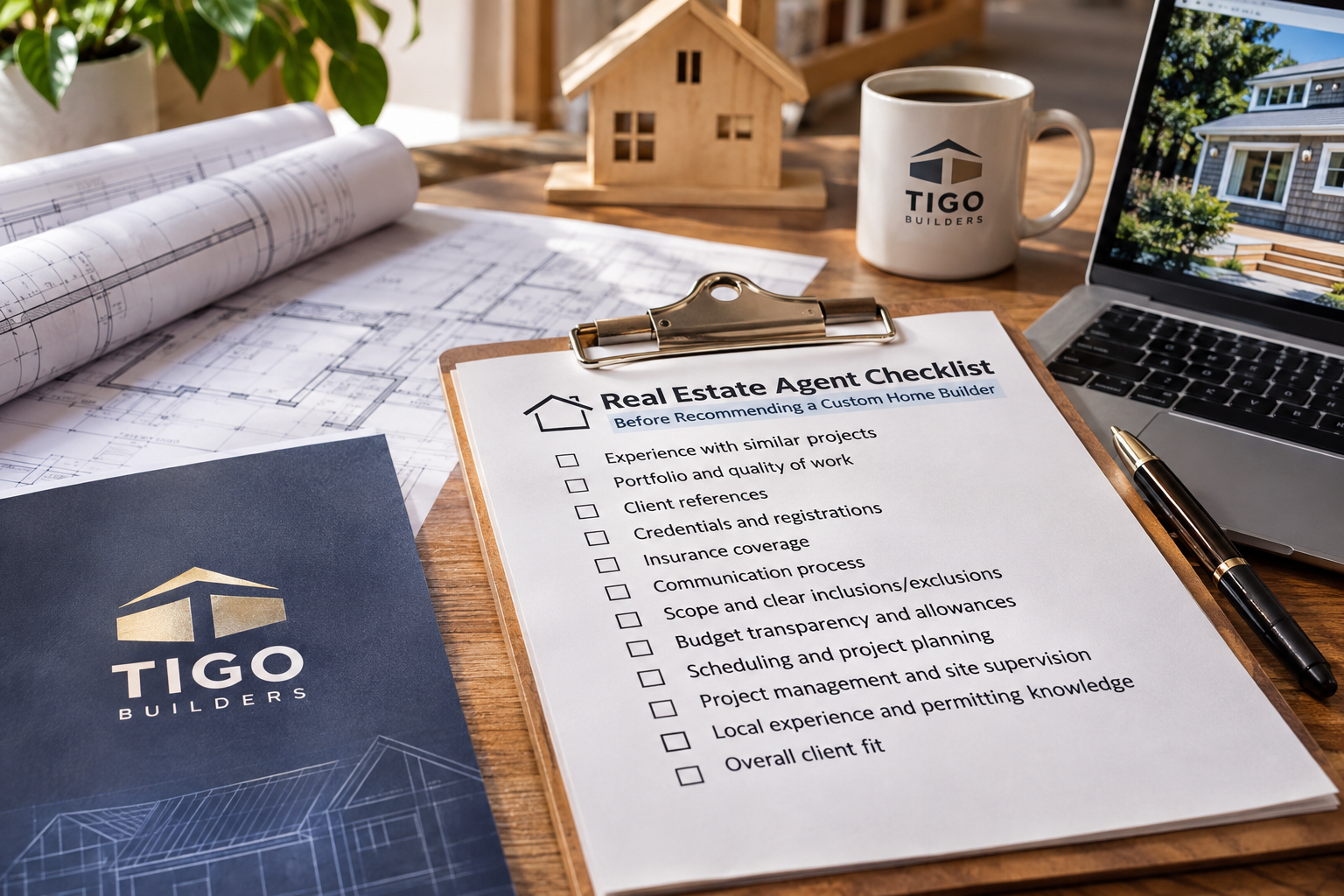
What Should Be Included in a Custom Home Builder Referral Checklist?
A practical Custom Home Builder Referral Checklist may include:
- Relevant construction experience
- Similar completed projects
- Portfolio quality
- Client references
- Applicable credentials
- Insurance documentation
- Local experience
- Communication process
- Primary project contact
- Scope clarity
- Budget transparency
- Allowance clarity
- Exclusion clarity
- Scheduling approach
- Architect collaboration
- Change-order process
- Project management
- Quality-control process
- Problem-solving approach
- Client fit
The checklist should guide due diligence.
It cannot guarantee that every project will proceed without unexpected conditions or disagreements.
However, it can help clients identify important questions before committing to a builder.
How Can Local Experience Support a Referral?
Experience in Cape Cod, MA may help a builder understand local project coordination, permitting processes, suppliers, logistics, and seasonal planning.
However, properties vary.
A Custom Home project in Falmouth, MA may have different requirements from one in Mashpee, MA or Bourne, MA.
The same applies to projects in Sandwich, MA and Woods Hole, MA.
Local familiarity should support project-specific planning rather than replace it.
What Should Agents Look for in Builder Communication?
A strong communication process should make it easy for clients to understand what is happening.
That may include:
- Progress information
- Upcoming decisions
- Budget changes
- Schedule changes
- Material selections
- Problems
- Change requests
- Approvals
For Tigo Builders, proactive communication and documented decisions are important parts of project management.
Why Does Transparent Budgeting Matter in a Referral?
Clients should understand how pricing connects with scope.
A builder should be able to explain major assumptions, allowances, exclusions, selections, and changes.
Transparent budgeting does not mean the project cost can never change.
It means changes should have understandable reasons and documentation.
Why Should Quality Control Be Part of the Referral Checklist?
Finished photographs show only one part of quality.
Agents can also ask how the builder reviews workmanship during construction.
Quality control may involve:
- Material verification
- Detail review
- Trade coordination
- Corrective work
- Progress checks
- Final punch-list work
A builder should be able to explain how quality expectations move from plans to completed work.
Frequently Asked Questions About Custom Home Builder Referrals
Why Should Real Estate Agents Use a Custom Home Builder Referral Checklist?
A Custom Home Builder Referral Checklist creates a consistent way to evaluate experience, references, credentials, communication, scope, budgeting, scheduling, quality, and client fit.
It helps agents make more informed introductions.
What Should an Agent Verify Before Recommending a Builder?
Agents should consider experience, references, relevant credentials, insurance, project type, communication, pricing approach, scheduling, project management, and quality-control processes.
Clients should still perform their own verification.
Should Agents Check Builder References?
Yes, references can provide valuable information about the client experience.
They may reveal how the builder communicated, handled changes, managed problems, and delivered the expected quality.
How Important Is Builder Communication?
Communication is especially important because construction requires frequent decisions and coordination.
Clients should know who their contact is, how updates are provided, and how problems, budget changes, and schedule changes are discussed.
Should Real Estate Agents Recommend More Than One Builder?
Providing multiple qualified options can help clients compare experience, communication, project fit, scope, budget approach, and quality expectations.
However, the right approach depends on the agent and situation.
What Warning Signs Should Agents Watch For?
Agents should pay attention to unclear scope, weak references, inconsistent communication, vague estimates, unexplained allowances, unsupported schedule promises, limited documentation, and unclear change or quality-control processes.
How Can Agents Help Second-Home Buyers Choose a Builder?
Agents can encourage second-home buyers to evaluate remote communication systems.
Progress photos, written updates, documented approvals, budget updates, schedule information, and decision deadlines can help clients stay involved from a distance.
Conclusion: Why Does a Thoughtful Builder Referral Matter?
A builder recommendation can influence both the construction experience and the trust a client places in their real estate professional.
Therefore, a thoughtful referral should evaluate more than reputation alone.
Experience shows whether the builder has handled relevant projects.
References provide insight into past client experiences.
Credentials and insurance help clients verify important business information.
Scope clarity helps the client understand what is being priced.
Budget transparency provides context for allowances, exclusions, selections, and changes.
Realistic scheduling helps clients understand the planning behind important dates.
Project management connects communication, procurement, trades, documentation, and quality control.
Architect coordination can help protect design intent while resolving construction questions.
Problem-solving reveals how the builder responds when conditions change.
Finally, client fit helps determine whether the builder’s communication and working style match the homeowner’s expectations.
No Custom Home Builder Referral Checklist can guarantee a perfect construction experience.
However, a strong Custom Home Builder Referral Checklist can help real estate professionals and clients ask better questions before making an important decision.
Clients should look for a Custom Home Builder who communicates clearly, documents important decisions, coordinates professionals and trades, and manages construction responsibly.
Tigo Builders values clear expectations, proactive communication, transparent budgeting, realistic scheduling, architect-builder collaboration, detailed project management, precise craftsmanship, quality control, and responsible problem-solving.
Contact Tigo Builders Today… to discuss Custom Home plans, project scope, pre-construction planning, construction budgets, scheduling, material selections, communication expectations, architect coordination, quality expectations, and construction execution for your clients.