Introduction
The most common mistakes when Hiring a Custom Home Builder include choosing only by price, skipping experience checks, accepting unclear scope, ignoring poor communication, weak budgeting, incomplete contracts, unrealistic timelines, limited references, late builder involvement, and no defined process.
Author: Tigo Builders
Last Updated: October 16, 2026
Building a Custom Home requires more than finding someone who can complete construction work.
The builder becomes a key part of planning, budgeting, coordination, scheduling, procurement, problem-solving, and execution.
Therefore, builder selection can affect both the finished home and the homeowner’s experience throughout construction.
Choosing carefully is especially important when the home includes custom details, specialized materials, complex architecture, or multiple design professionals.
For owners of second homes, communication and project management can matter even more.
The homeowner may not be available to visit the property every day.
As a result, the builder must be able to communicate decisions, progress, budget changes, and schedule updates clearly.
What Are the Most Common Mistakes When Hiring a Custom Home Builder?
Many mistakes happen because homeowners compare builders before understanding what should actually be compared.
Price is only one factor.
Experience, scope, communication, planning, references, and project management also deserve attention.
Common mistakes include:
- Choosing only by total price
- Skipping reference checks
- Ignoring relevant experience
- Accepting vague proposals
- Overlooking allowances
- Ignoring exclusions
- Accepting unrealistic schedules
- Evaluating communication too late
- Bringing the builder in too late
- Failing to understand the process
Each issue can create uncertainty later.
The goal is not to find a “perfect” builder.
Instead, homeowners should look for a builder whose experience, process, communication, and expectations fit the specific project.
Is Choosing the Lowest Bid a Mistake?
Choosing the lowest bid only because it is the lowest can be a mistake.
However, choosing the highest bid does not guarantee better construction either.
The important question is what each proposal actually includes.
Two builders may be pricing very different scopes while using similar project descriptions.
One proposal may include more detailed finishes, supervision, or material allowances.
Another may exclude those items.
Therefore, total price should never be evaluated without context.
The National Association of Home Builders advises consumers to be cautious about unusually low bids and to evaluate the builder beyond price alone.
That does not mean a lower proposal is automatically a problem.
Instead, it means the homeowner should understand why the number is different.
Why Is Comparing Builders Only by Price a Mistake?
Builders may make different assumptions about the same project.
Those assumptions can significantly affect the proposed price.
Differences may involve:
- Scope
- Materials
- Labor
- Allowances
- Exclusions
- Supervision
- Project management
- Quality expectations
- Schedule assumptions
- Specialty trades
For example, two proposals may both list “custom cabinetry.”
However, the type of cabinetry, hardware, installation, finish, and interior accessories may be very different.
The same issue can occur with flooring, windows, millwork, tile, countertops, siding, and other materials.
Therefore, compare the details before comparing the totals.
Why Should You Verify a Builder’s Experience?
Relevant experience helps show whether the builder has worked through challenges similar to those expected in your project.
Custom Home construction can require extensive coordination.
Architects, engineers, designers, suppliers, fabricators, subcontractors, inspectors, and homeowners may all be involved.
A builder must coordinate these relationships while keeping construction moving.
Experience with that environment can be more useful than a general statement such as “we have been building for many years.”
Does the Number of Years in Business Prove Quality?
No.
Longevity may provide useful context, but it should not be the only measure of capability.
Relevant project experience matters.
A builder may have many years of experience in one type of construction but limited experience with detailed Custom Homes.
Therefore, ask what kinds of projects the builder has completed.
Also ask what role the builder played in planning, coordination, and execution.
Why Does Relevant Custom Home Experience Matter?
Custom Homes often involve decisions that standard construction may not require at the same level.
These can include custom details, unusual materials, specialty fabrication, complex selections, and architectural coordination.
The builder may need to work directly with:
- Architects
- Interior designers
- Engineers
- Cabinetmakers
- Specialty fabricators
- Landscape professionals
- Suppliers
- Specialty subcontractors
Moreover, design decisions may continue to evolve as pricing, availability, and construction details are refined.
A builder should be comfortable working within that collaborative process.
What Should You Look for in a Builder’s Portfolio?
Look for projects that resemble your project in complexity, scope, craftsmanship, or architectural expectations.
They do not need to look exactly like your future home.
A varied portfolio can also demonstrate flexibility.
However, the work should provide evidence that the builder understands the quality level you expect.
Consider features such as:
- Finish carpentry
- Cabinetry
- Exterior detailing
- Material transitions
- Kitchens
- Bathrooms
- Decks
- Outdoor living spaces
- Additions
- Custom architectural details
Photos can help evaluate visible craftsmanship.
However, photographs alone cannot show how the project was managed.
Why Aren’t Attractive Project Photos Enough?
A beautiful photograph shows the finished result.
It does not reveal what happened during construction.
You cannot see communication, budget management, scheduling, change orders, or problem-solving in a finished image.
Therefore, ask about the story behind the project.
What challenges occurred?
How were they addressed?
How did the builder coordinate with the architect and homeowner?
What parts of the project required the most planning?
Those answers may reveal more than the photographs themselves.
Why Are References Important?
References allow prospective clients to learn how the builder performed during a real project.
The NAHB recommends asking builders for previous customers and checking whether those clients would hire the builder again.
That conversation can provide insight beyond craftsmanship.
For example, a former client may describe how clearly budget changes were discussed.
Another may explain how the builder handled an unexpected issue.
What Should You Ask Previous Clients?
Avoid asking only whether they were satisfied.
Specific questions usually provide more useful information.
Consider asking:
- Was communication consistent?
- Were budget discussions clear?
- How were changes handled?
- Were schedule updates realistic?
- Was the jobsite organized?
- Were problems addressed promptly?
- How was the final craftsmanship?
- Would you hire the builder again?
Additionally, ask whether expectations established before construction matched the actual experience.
That comparison can reveal how accurately the builder presents the process.
Should You Ask to See Work in Progress?
When appropriate and permitted, seeing current work may provide useful context.
The NAHB recommends asking whether you can view both completed projects and work in progress.
An active project can show aspects that finished photography does not.
For example, you may observe site organization, material protection, sequencing, and general workmanship.
However, homeowners should respect the privacy and safety requirements of active jobsites.
Why Is Communication Style Important?
A Custom Home project can require months of decisions and coordination.
Therefore, the builder’s communication style should fit the homeowner and design team.
Good communication does not mean sending constant messages.
It means providing relevant information clearly and at useful times.
Homeowners should understand how questions, approvals, selections, schedule changes, and budget updates will be communicated.
What Should You Evaluate During Early Conversations?
Pay attention to how the builder handles questions before you sign anything.
Does the builder explain the process clearly?
Are answers specific or vague?
Does the builder ask questions about your priorities?
Consider:
- Responsiveness
- Clarity
- Organization
- Documentation
- Follow-up
- Budget discussions
- Schedule discussions
- Decision expectations
Hiring a Custom Home Builder creates a long working relationship.
Therefore, early communication deserves serious attention.
Can Poor Communication During Sales Be a Warning Sign?
It can be.
One delayed response does not prove that a builder communicates poorly.
However, repeated unclear answers or inconsistent follow-up may deserve closer attention.
The NAHB specifically encourages consumers to consider whether they can communicate easily with a prospective builder.
Construction creates many situations where quick clarity matters.
Therefore, evaluate communication before committing to the relationship.
Why Is Hiring Before Defining Project Priorities a Mistake?
A builder cannot accurately understand the project if the owner has not defined what matters most.
Priorities influence scope, budget, schedule, and material decisions.
Before Hiring a Custom Home Builder, consider what is essential.
For example:
- Architectural character
- Kitchen quality
- Outdoor living
- Energy performance
- Custom millwork
- Low-maintenance materials
- Seasonal completion
- Long-term durability
Not every goal needs to be fully resolved.
However, identifying major priorities helps the builder understand what the project is trying to achieve.
Why Is an Unclear Scope Dangerous?
An unclear scope makes pricing and expectations difficult to compare.
It can also create disagreement about what was assumed to be included.
A proposal should provide enough detail for the homeowner to understand what is being priced.
That does not mean every finish must already be selected.
However, unresolved items should be visible.
If something is unknown, it should not appear as though it has already been fully defined.
What Should You Understand About the Scope?
Before comparing proposals, determine what each builder has included.
Important questions include:
- What work is included?
- What work is excluded?
- What remains an allowance?
- What is owner-supplied?
- What is not yet priced?
- What assumptions were used?
- What may require additional pricing?
Clear answers help create a more meaningful comparison.
Without them, a lower price may simply reflect a smaller scope.
Why Should You Review Allowances?
Allowances are often used for items that have not been fully selected when pricing is prepared.
They can be useful.
However, the homeowner should understand what quality level the allowance represents.
An allowance for tile, for example, may not match the homeowner’s expectations for the finished design.
The same issue can apply to lighting, plumbing fixtures, appliances, flooring, hardware, or countertops.
Consequently, an unrealistic allowance can make the initial construction budget look lower than the likely final selections.
Why Should You Review Exclusions?
Exclusions identify work or products that are not part of the proposed price.
They matter just as much as included items.
A homeowner may assume landscaping, appliances, specialty systems, design services, or certain site work are included when they are not.
Therefore, exclusions should be reviewed before proposals are compared.
Ask questions whenever the responsibility for an item is unclear.
What Does “Owner-Supplied” Mean for the Project?
Owner-supplied items are products or materials purchased or provided by the homeowner rather than the builder.
The responsibilities surrounding those items should be clear.
Who orders the product?
Who verifies dimensions?
Who receives it?
Who stores it?
Who coordinates installation?
These details can influence both schedule and responsibility.
Therefore, “owner-supplied” should not be treated as a minor note.
Why Is Preliminary Pricing Easy to Misunderstand?
Early pricing often includes assumptions because the design and selections are still developing.
That is normal in many Custom Home projects.
The mistake is treating preliminary pricing as though every cost is already fixed.
Instead, ask what information supports the estimate.
Some categories may be based on drawings.
Others may rely on allowances or historical pricing.
Understanding those differences helps homeowners evaluate the construction budget realistically.
Why Should Budget Transparency Matter Before Hiring?
Budget transparency allows homeowners to understand how the builder arrived at the proposed cost.
It also makes future discussions easier.
A transparent budget should make major assumptions visible.
It should not require the homeowner to guess what is included.
For owners building a second or third home, clear documentation can be especially valuable because many decisions may happen remotely.
Why Are Unrealistic Promises a Concern?
Custom Home projects involve variables.
Permitting, selections, engineering, procurement, inspections, weather, subcontractor coordination, and owner decisions may all affect the schedule.
Therefore, homeowners should be cautious when a builder makes a very aggressive promise without explaining how the schedule was developed.
A realistic timeline should be based on the actual project.
What Should a Builder Explain About the Schedule?
The builder should be able to describe major phases and important dependencies.
The schedule may evolve, but the planning logic should be understandable.
Ask about:
- Pre-construction
- Permitting
- Procurement
- Site work
- Framing
- Rough trades
- Inspections
- Finishes
- Owner selections
- Final completion
Also ask which decisions must be made early to protect the timeline.
Late selections can affect ordering and sequencing.
Why Does Local Project Knowledge Matter?
Local experience can help a builder understand construction logistics, permitting processes, suppliers, subcontractor availability, and seasonal project conditions.
However, local experience should still be evaluated together with project-specific qualifications.
Tigo Builders works with homeowners and design professionals throughout Cape Cod, including projects around Falmouth and nearby communities.
These may include Mashpee, Bourne, Sandwich, and Woods Hole.
Each property should still be evaluated individually.
Site access, design, permitting needs, coastal exposure, existing conditions, and owner schedules can vary significantly from one project to another.
Why Is Waiting Too Long to Involve the Builder a Mistake?
Late builder involvement can reduce opportunities to discuss cost, constructability, procurement, and schedule while the design is still flexible.
The American Institute of Architects supports collaborative project delivery with early and consistent involvement among owners, architects, engineers, and constructors.
In May 2026, the AIA and AGC also released a framework emphasizing early alignment, clear roles, open communication, and contractor engagement during design.
For a Custom Home, that collaboration can help the team evaluate important decisions before they become difficult or expensive to revise.
How Can Early Builder Involvement Improve Cost Planning?
The builder can provide construction feedback while the architect is developing the design.
That feedback may involve materials, labor, sequencing, structural complexity, or specialty work.
For example, a detail may look simple on a drawing but require significant fabrication in the field.
Identifying that issue early creates options.
The architect may preserve the detail.
Alternatively, the team may explore another solution that achieves a similar design goal with less complexity.
How Can Early Involvement Support Procurement?
Some Custom Home products require decisions well before installation.
Examples may include windows, doors, cabinetry, specialty hardware, millwork, or fabricated components.
Actual lead times should always be verified with suppliers.
However, identifying potentially long-lead categories early gives the team more time to coordinate selections with the project schedule.
How Can Early Involvement Support Value Engineering?
Value engineering works best when alternatives can still be evaluated without disrupting completed work.
It should not simply mean choosing cheaper products.
Instead, the team can compare design importance, cost, durability, installation, maintenance, availability, and construction complexity.
The builder provides construction input.
The architect protects design intent.
Meanwhile, the homeowner determines which priorities matter most.
How Should Architects Evaluate a Potential Builder?
Architects should consider whether the builder can understand and execute the level of detail required by the design.
Relevant experience is important.
So is collaboration.
The builder should be comfortable discussing drawings, specifications, constructability, material choices, sequencing, and field conditions.
Additionally, architects should evaluate whether the builder communicates questions clearly instead of making assumptions when information needs clarification.
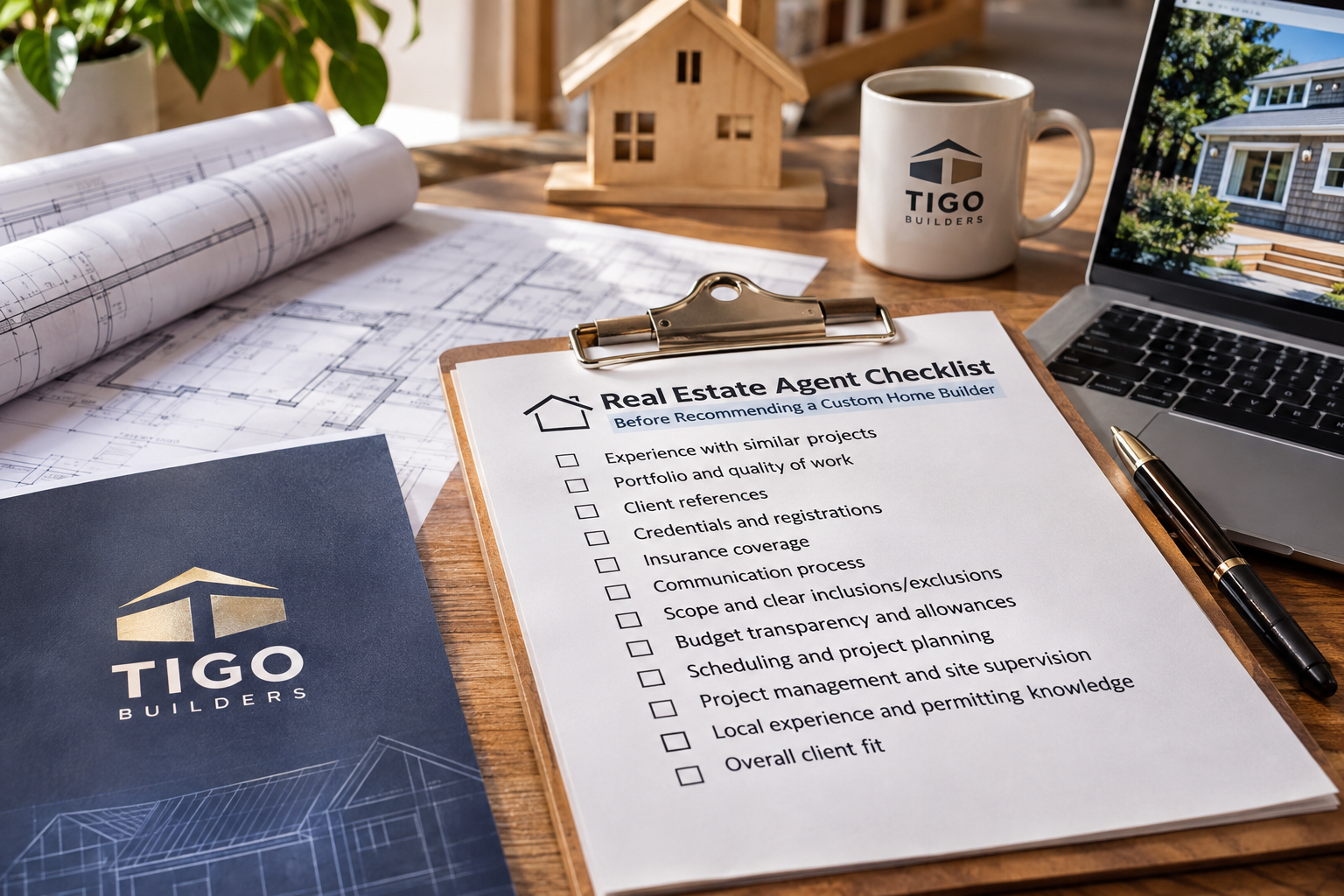
How Can Real Estate Agents Evaluate Builders Before Making a Recommendation?
Real estate professionals can consider reputation, relevant experience, references, communication, and professionalism before suggesting a builder.
However, a recommendation should not replace the client’s own evaluation.
The homeowner should still interview the builder, review the proposed scope, check references, and understand the project process.
Hiring a Custom Home Builder is ultimately a project-specific decision.
Why Should the Builder’s Process Matter?
A strong portfolio shows what a builder has completed.
A clear process explains how the next project will be managed.
Ask what happens after the first meeting.
How is scope developed?
When is pricing updated?
How are selections tracked?
How are decisions documented?
How are changes handled?
These questions begin to reveal whether the builder has a repeatable approach to project management.
What Should Happen Before Construction Begins?
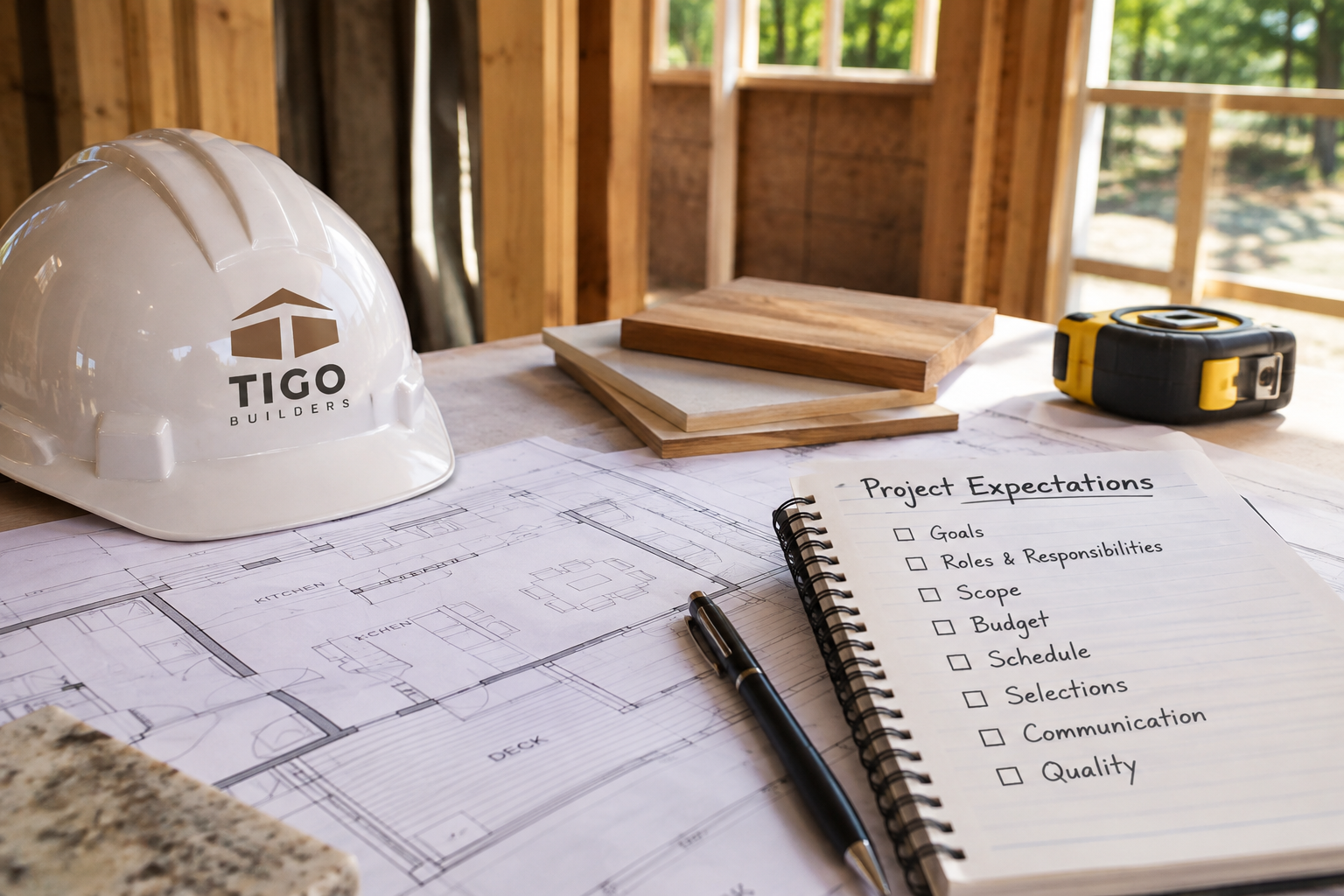
Before construction, the team should work toward alignment on design, scope, budget, schedule, selections, responsibilities, and important procurement decisions.
The exact process varies by project.
Tigo Builders emphasizes early planning, clear communication, budget transparency, realistic scheduling, and collaboration with homeowners and design professionals.
These principles help create clearer expectations before work begins.
However, builder selection should not stop with portfolio, references, pricing, and communication.
Before Hiring a Custom Home Builder, homeowners should also examine the construction agreement, credentials, insurance, change-order process, project management structure, and each party’s responsibilities.
Those details can reveal additional warning signs and help determine whether the builder’s process is prepared to support the project from pre-construction through final completion.
Why Is Signing an Incomplete Contract a Mistake?
An incomplete construction agreement can leave important responsibilities, costs, and expectations unclear.
Before signing, homeowners should understand what the agreement actually covers.
The contract should reflect the project information available at that stage and identify areas that remain unresolved.
Additionally, questions should be addressed before construction begins whenever practical.
The NAHB recommends obtaining a complete, clearly written contract when selecting a builder or remodeler.
What Should a Custom Home Contract Clearly Explain?
A construction agreement should explain how the project relationship will work.
Important areas may include:
- Project scope
- Pricing structure
- Payment schedule
- Allowances
- Exclusions
- Change procedures
- Schedule expectations
- Owner responsibilities
- Documentation
- Applicable dispute procedures
The exact agreement depends on the project.
Therefore, homeowners should seek qualified legal advice when they need help understanding contractual rights or obligations.
This article provides construction-planning information, not legal advice.
Why Should Scope and Pricing Match the Contract?
The written agreement should reflect the scope the homeowner believes they are purchasing.
If important work is missing, the total contract amount may not represent the expected project.
For example, custom millwork may appear in architectural drawings but require clarification in the construction scope.
The same can occur with appliances, landscaping, specialty finishes, site work, or owner-supplied materials.
Before Hiring a Custom Home Builder, compare the proposal, drawings, specifications, allowances, and contract for consistency.
Why Should Payment Expectations Be Clear?
Homeowners should understand when payments are expected and what those payments relate to.
A payment schedule should not be something discovered after construction begins.
Clear expectations help the homeowner plan financially.
They also give both parties a common reference for future discussions.
Why Should You Understand the Change-Order Process?
Changes are common enough in custom construction that homeowners should understand how they will be managed before work begins.
A change may affect both cost and schedule.
Changes can result from:
- Owner requests
- Design revisions
- Site conditions
- Product substitutions
- Scope revisions
Not every change indicates poor planning.
Some conditions cannot be fully identified before construction.
However, avoidable changes can often be reduced through early decisions and clear documentation.
How Should Change Orders Be Communicated?
Whenever practical, the homeowner should understand the proposed change, cost impact, and potential schedule impact before approving the work.
This creates a clearer decision process.
A documented process can also prevent confusion about whether a conversation was only exploratory or represented an approved change.
Consequently, change management should be discussed when Hiring a Custom Home Builder, not after the first change occurs.
Why Are Unrealistic Timelines a Warning Sign?
A Custom Home schedule depends on several connected factors.
A timeline that sounds unusually aggressive should come with an understandable plan.
Important variables can include:
- Design completion
- Permitting
- Inspections
- Material availability
- Long-lead products
- Subcontractor scheduling
- Weather
- Owner decisions
- Site conditions
No responsible schedule can ignore project-specific conditions.
Therefore, homeowners should ask how the proposed timeline was developed.
Why Do Owner Decisions Affect the Schedule?
Some construction activities cannot move forward until selections or approvals are complete.
Late decisions can affect procurement and trade coordination.
For example, cabinetry information may influence electrical, plumbing, appliance, and finish planning.
Windows and doors may also need to be finalized before certain later activities can proceed.
A clear decision schedule helps homeowners understand when their input is needed.
Why Should Long-Lead Items Be Discussed Before Construction?
Certain products may require significant time for ordering, fabrication, or delivery.
Actual lead times vary and should always be confirmed with suppliers.
Potential examples include:
- Windows
- Exterior doors
- Cabinetry
- Custom millwork
- Specialty hardware
- Fabricated components
- Specialty finishes
Identifying these categories early helps connect procurement with the construction schedule.
What Credentials Should Homeowners Verify?
Homeowners should verify the licenses, registrations, insurance, and other requirements applicable to their specific project and jurisdiction.
Requirements are not identical for every project.
In Massachusetts, a Construction Supervisor License and Home Improvement Contractor Registration are different credentials and are not interchangeable.
The required credentials depend on the type and scope of work.
Therefore, homeowners should use official Massachusetts and local resources when verifying requirements.
What Is the Difference Between a CSL and HIC Registration?
A Massachusetts Construction Supervisor License relates to supervising certain construction work covered by applicable building-code requirements.
Mass.gov states that certain projects require oversight by a licensed construction supervisor or registered design professional.
Home Improvement Contractor Registration applies to qualifying work on existing owner-occupied residential properties with one to four units.
Massachusetts specifically states that HIC Registration and a CSL are different and not interchangeable.
Therefore, homeowners should not assume that one credential automatically satisfies every requirement.
Why Is Insurance Important?
Insurance should be part of the builder evaluation process.
The NAHB recommends confirming that a builder or remodeler has appropriate workers’ compensation and general liability insurance.
Homeowners should ask for current documentation relevant to their project.
If questions remain, they can consult their own insurance professional or other qualified adviser.
Why Does Local Knowledge Matter?
Local knowledge can help with permitting, inspections, construction logistics, suppliers, scheduling, and coordination.
However, local familiarity should complement relevant Custom Home experience rather than replace it.
For example, the Town of Falmouth Building Department administers local building permits and inspections.
Its published inspection procedures include multiple stages for new construction and additions or alterations.
Projects elsewhere in Cape Cod may involve different local procedures.
Therefore, requirements should always be confirmed for the actual project location.
Why Should Responsibilities Be Clear Before Construction?
The homeowner, architect, builder, designer, and consultants may each have different responsibilities.
Confusion can occur when those roles are assumed rather than discussed.
Questions may include:
- Who approves selections?
- Who communicates design revisions?
- Who coordinates consultants?
- Who orders specific materials?
- Who tracks owner decisions?
- Who reviews substitutions?
Clear responsibilities help reduce duplicated work and missed decisions.
Why Is Project Management Important?
Custom Home construction requires more than skilled trades.
The project must also be organized.
Project management may involve:
- Scheduling
- Trade coordination
- Procurement
- Quality control
- Documentation
- Budget tracking
- Communication
- Inspections
- Problem-solving
A beautiful design still requires coordinated execution.
Therefore, homeowners should ask how the builder manages these responsibilities.
Who Will Manage the Project Day to Day?
This is an important question when Hiring a Custom Home Builder.
The person involved during the sales process may not be the person managing daily construction.
Ask who will be responsible for the jobsite.
Also ask who communicates with the homeowner, architect, subcontractors, and suppliers.
Understanding the communication structure helps prevent confusion once construction begins.
Why Should You Understand the Builder’s Communication System?
Communication should have a clear structure.
Homeowners should know how important information will reach them.
Ask:
- Who is my main contact?
- How often are updates provided?
- How are selections tracked?
- How are decisions documented?
- How are budget changes shared?
- How are schedule changes shared?
The exact system can vary.
Consistency and clarity matter more than using any particular platform.
Why Is Communication Especially Important for Second-Home Owners?
Owners of second or third homes may spend significant time away from the construction site.
They need enough information to make decisions without being physically present every day.
Photos, written updates, decision records, budget information, and schedule communication can help owners stay involved remotely.
For projects around Falmouth, Mashpee, Bourne, Sandwich, and Woods Hole, this can be especially valuable for seasonal residents.
What Warning Signs Should You Watch for When Hiring a Custom Home Builder?
A warning sign does not automatically prove that a builder is unsuitable.
However, several unresolved concerns should encourage closer evaluation.
Potential warning signs include:
- Unclear scope
- Pressure to sign immediately
- Refusal to provide references
- Unclear pricing
- Unrealistic promises
- Repeated poor communication
- Incomplete documentation
- No clear change-order process
- No explanation of project management
- Limited relevant experience
The NAHB specifically recommends references, clear contracts, communication evaluation, insurance verification, and caution with unusually low bids.
Use warning signs as reasons to ask better questions.
Do not make decisions based on one isolated issue without context.
Is Pressure to Sign Quickly a Concern?
It can be.
A Custom Home is a major project, and homeowners should have time to understand the scope, budget, schedule, and agreement.
Legitimate scheduling constraints may exist.
However, those constraints should be explained clearly.
Hiring a Custom Home Builder should be an informed decision rather than a reaction to unnecessary pressure.
Why Is an Unclear Process a Concern?
If a builder cannot explain what happens between contract signing and final completion, homeowners may struggle to understand how decisions will be managed.
Ask about major steps.
For example:
- Pre-construction
- Permitting
- Procurement
- Construction
- Inspections
- Selections
- Changes
- Quality reviews
- Project completion
The process does not need to be identical for every home.
It should still be understandable.
How Can Architects Help Homeowners Evaluate a Builder?
Architects can evaluate how well a builder interacts with the technical and design requirements of the project.
They may consider whether the builder understands:
- Drawings
- Specifications
- Design intent
- Constructability
- Coordination
- Craftsmanship expectations
- Project communication
A builder should be willing to ask questions when clarification is needed.
That is often preferable to making assumptions about important design details.
Why Does the Architect-Builder Relationship Matter?
Architects and builders bring different expertise to the project.
The architect develops and protects design intent.
The builder translates that information into construction planning and field execution.
Strong collaboration can improve coordination between design decisions and construction realities.
For homeowners, this can support clearer decisions about cost, materials, schedule, and details.
How Can Real Estate Agents Recommend Builders Responsibly?
Real estate professionals can provide useful introductions without guaranteeing a builder’s performance.
Recommendations should encourage clients to complete their own evaluation.
Agents can consider:
- Reputation
- References
- Communication
- Relevant experience
- Professionalism
- Local knowledge
The homeowner should still interview the builder and review the project-specific proposal.
A builder who fits one client may not automatically be the right fit for another.
What Should You Check Before Hiring a Custom Home Builder?
Use this checklist before making a final selection:
- Relevant Custom Home experience
- Portfolio
- References
- Communication style
- Scope clarity
- Budget transparency
- Allowances
- Exclusions
- Applicable credentials
- Insurance
- Construction agreement
- Change-order process
- Project management
- Schedule expectations
- Material planning
- Long-lead items
- Quality expectations
- Main point of contact
- Problem-solving approach
- Final questions
Do not treat the checklist as a simple scorecard.
The goal is to understand how the builder will actually manage your project.
What Final Questions Should You Ask the Builder?
Before Hiring a Custom Home Builder, ask questions that reveal both experience and process.
Consider asking:
- Who will manage my project?
- How will you communicate updates?
- How are budget changes handled?
- How are change orders approved?
- How are selections tracked?
- How do you build the schedule?
- How do you handle unexpected issues?
- What decisions will I need to make early?
The quality of the answers matters.
Clear, project-specific explanations are more useful than generic promises.
How Does Tigo Builders Approach Custom Home Projects?
Tigo Builders emphasizes early planning, transparent budgeting, realistic scheduling, clear communication, detailed project management, and precise craftsmanship.
The company works with homeowners and design professionals to connect design intent with construction execution.
That includes discussing scope, materials, budget priorities, schedule expectations, and project decisions before and during construction.
For second-home owners, proactive communication can also help maintain visibility when they are away from Cape Cod.
The objective is to establish clear expectations early and maintain that clarity as the project progresses.
Frequently Asked Questions About Hiring a Custom Home Builder
What Is the Biggest Mistake When Hiring a Custom Home Builder?
Choosing based on one factor alone is one of the biggest risks.
Price, portfolio, or personality should not replace a complete evaluation of experience, references, scope, communication, budgeting, and project management.
Should I Choose the Builder With the Lowest Bid?
Not automatically.
Compare scope, allowances, exclusions, materials, supervision, project management, and assumptions before comparing total prices.
A lower or higher number does not prove value by itself.
How Many References Should I Ask For?
There is no universal number that fits every project.
The goal is to speak with enough relevant previous clients to understand patterns in communication, scheduling, budgeting, problem-solving, and craftsmanship.
What Should a Builder Contract Include?
It should clearly document the project relationship based on the specific agreement.
Important areas may include scope, pricing, payment terms, allowances, exclusions, change procedures, schedule expectations, and responsibilities.
Why Is Communication Important?
Custom Homes require ongoing decisions.
Clear communication helps homeowners understand budget changes, schedule developments, selections, approvals, and unexpected conditions as the project progresses.
When Should I Involve a Builder?
Builder involvement can be valuable during planning and design, before major decisions become difficult to change.
Early collaboration can support budgeting, constructability, procurement, and schedule planning.
What Should I Ask Before Signing a Contract?
Ask about scope, exclusions, allowances, credentials, insurance, project management, scheduling, communication, changes, selections, responsibilities, and how unexpected conditions are handled.
Conclusion: How Can You Avoid Mistakes When Hiring a Custom Home Builder?
Hiring a Custom Home Builder should involve much more than comparing prices.
The right selection process examines relevant experience, references, communication, scope, pricing, schedule expectations, project management, and craftsmanship.
Clear scope helps homeowners understand what they are purchasing.
Transparent pricing helps them understand what has been included, excluded, or left as an allowance.
References provide insight into the actual client experience.
Meanwhile, realistic scheduling helps set expectations before construction begins.
Contracts and applicable credentials deserve careful review.
Change-order procedures should also be understood before changes occur.
Project management determines how trades, materials, inspections, schedules, decisions, and communication come together during construction.
Additionally, collaboration with architects and designers can help protect both design intent and construction execution.
Ultimately, the right builder should create greater clarity before work begins and maintain that clarity throughout the project.
That is especially important in Custom Home construction, where every project has unique priorities, details, materials, and challenges.
Avoiding common hiring mistakes does not require knowing everything about construction.
It requires asking informed questions and expecting clear answers.
For homeowners, architects, designers, and real estate professionals, a thoughtful builder-selection process can create a stronger foundation for the entire project.
Contact Tigo Builders Today… to discuss your project scope, budget, planning, scheduling, communication, quality expectations, and construction execution before Hiring a Custom Home Builder for your next Custom Home.